The evolving security relationship between the Philippines and Taiwan is becoming a quiet but significant feature of Indo-Pacific geopolitics. As tensions rise around the Taiwan Strait, the southern edge of the Luzon Strait is turning into a strategic hinge. The United States is increasingly shaping this space through military infrastructure, joint exercises, and alliance integration. At the same time, Manila and Taipei are slowly developing their own informal security coordination. Together, these trends are reshaping how the first island chain is defended and contested.
From a great-power competition perspective, the United States is clearly strengthening its forward posture in the region. The expansion of the Enhanced Defense Cooperation Agreement (EDCA) sites in the Philippines reflects this shift. Key facilities in northern Luzon—such as Naval Base Camilo Osias in Cagayan, Lal-lo Airport, and Camp Melchor Dela Cruz—are positioned to face the Luzon Strait. These locations are not primarily relevant to South China Sea disputes. Instead, they are strategically aligned toward a potential Taiwan contingency. The deployment of the US Typhon missile system in Luzon further signals that deterrence planning now extends across the entire first island chain, including Taiwan’s southern approaches.
For China, this development is deeply sensitive. It sees the Philippines not only as a South China Sea claimant, but increasingly as a forward staging area for US power projection. Beijing’s concern is not just military hardware, but geography. Northern Luzon sits directly across from Taiwan’s southern waters. In this sense, the Philippines becomes part of the broader deterrence map. This intensifies great-power competition, as local Philippine territory is gradually absorbed into wider US–China strategic calculations.
Alliance dynamics are also evolving. The US–Philippines alliance has expanded through large-scale exercises such as Balikatan, which now include wider geographic coverage, more troops, and participation from partners like Japan, Australia, Canada, New Zealand, and others with access agreements. These exercises increasingly focus on maritime coordination across both the South China Sea and the Luzon Strait. In February 2026, a US–Japan–Philippines maritime activity near the Bashi Channel and Mavulis Island highlighted this trend. These drills are not only about training. They are about mapping operational familiarity with the geography surrounding Taiwan.
This emerging “latticework” of partnerships—sometimes called the San Francisco system—is gradually linking the Philippines into a wider Indo-Pacific security network. The inclusion of Japan and Australia in trilateral and quadrilateral formats reinforces this structure. While not formal alliances in the NATO sense, these arrangements are increasingly operational. They build interoperability, shared situational awareness, and crisis coordination capacity. However, they also increase the risk that the Philippines could be drawn into a Taiwan-related contingency that it does not directly control.
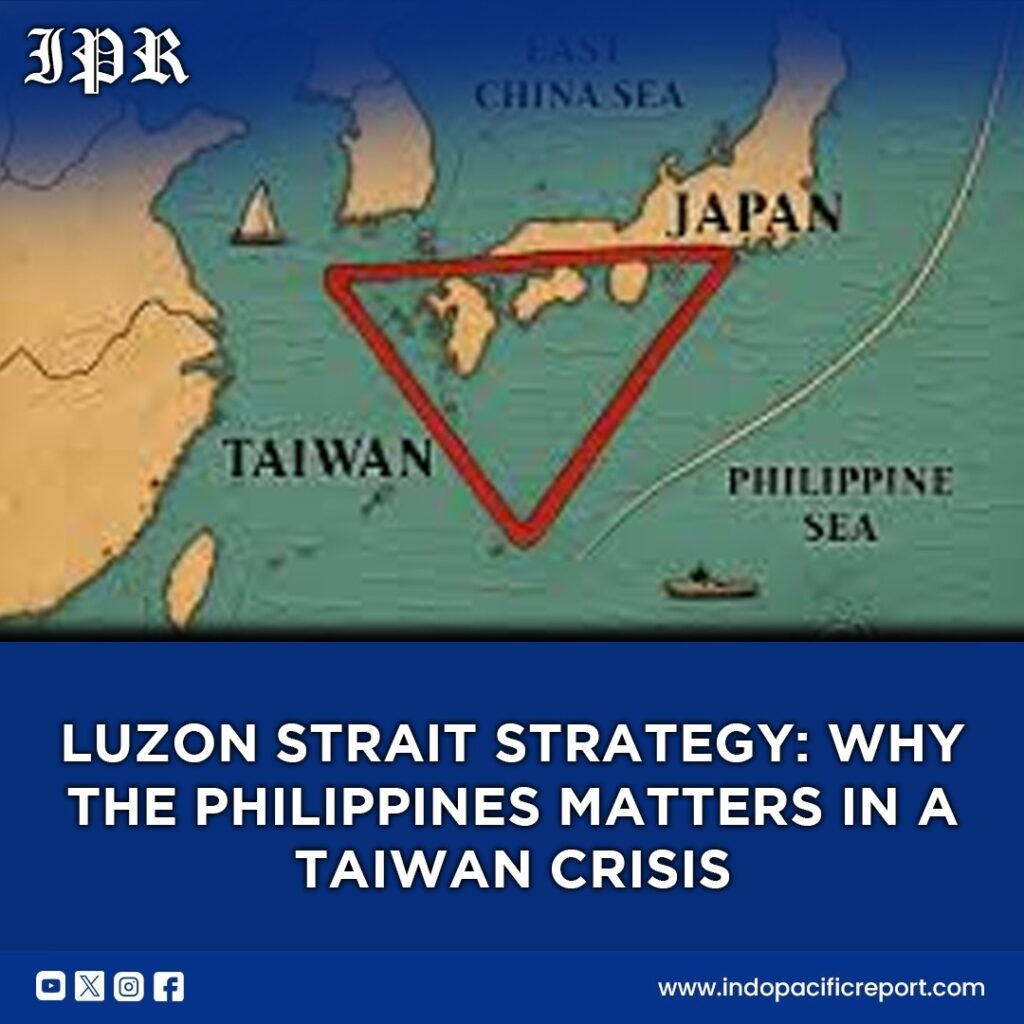
Maritime and economic geography is central to this shift. The Luzon Strait and Bashi Channel are not abstract lines on a map. They are critical sea lanes connecting the Pacific Ocean to the South China Sea. Control or influence over this corridor has direct implications for military movement, trade flows, and evacuation routes in a crisis scenario. The expansion of military access in northern Luzon therefore changes the strategic geometry of the first island chain. It turns the Philippines into both a defensive buffer and a potential operational platform in a wider Taiwan conflict scenario.
However, the Philippines is not a passive actor in this evolving structure. Manila is actively shaping its own role, even within constraints. One important factor is its large overseas workforce in Taiwan—over 200,000 Filipino workers. This creates a direct human security link between Manila and Taipei. In a crisis, evacuation, protection, and economic disruption would become immediate Philippine concerns. Taiwan is also an important economic partner, often underappreciated in Philippine foreign policy debates dominated by US–China rivalry.
This creates a strategic dilemma for Manila. On one hand, it benefits from deeper security integration with the United States and regional partners. On the other hand, it risks entrapment in a Taiwan contingency that could escalate rapidly and unpredictably. The Philippines must also manage domestic concerns, including local resistance to foreign bases in northern Luzon and fears of economic retaliation from China. This reflects the classic challenge of a weaker state embedded in a major power competition system: gaining security while limiting loss of autonomy.
There is also an emerging, quieter layer of Philippine–Taiwan interaction. Although unofficial, security-related communication and coordination between Manila and Taipei appear to be increasing. These exchanges are shaped by geography, shared maritime concerns, and crisis awareness in the Bashi Channel. While still limited and informal, they indicate that actors within the first island chain are not only responding to great-power strategies—they are also developing their own parallel channels of coordination.
From a broader Indo-Pacific perspective, the Philippines is becoming a key structural node in Taiwan security planning, whether formally acknowledged or not. The combination of US basing access, multinational exercises, and emerging regional coordination places northern Luzon at the edge of a potential crisis geography. This does not mean conflict is inevitable. But it does mean that the Philippines is increasingly embedded in the strategic architecture of Taiwan contingency planning.
Looking ahead, the central question is durability and control. As US–China competition intensifies, the operational integration of the Philippines into first island chain defense planning will deepen. But so will Manila’s exposure to risk. The challenge for Philippine strategy will be to balance deterrence cooperation with crisis avoidance. In an increasingly polarized Indo-Pacific, the Philippines is not just a partner state. It is becoming a geographic pivot in the wider balance of power.