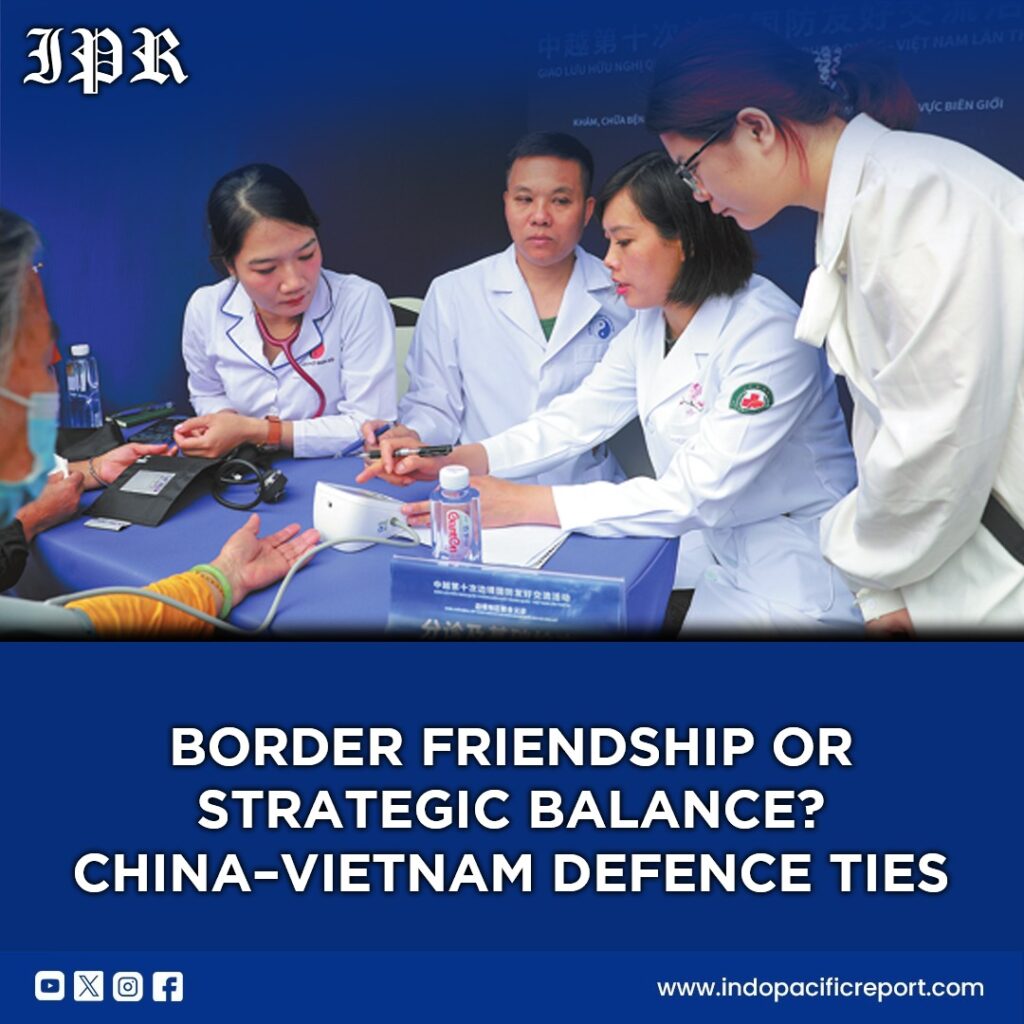
The recent China–Vietnam border defence friendship exchange, co-hosted by Dong Jun and Phan Van Giang, reflects a carefully managed layer of cooperation inside an otherwise complex and competitive Indo-Pacific security environment. On the surface, the event emphasizes friendship, joint patrols, and symbolic gestures such as tree planting and memorial visits. But beneath these rituals lies a deeper strategic logic: both countries are actively managing a long-standing rivalry while preventing escalation along their shared border and maritime frontier.
From a great-power competition perspective, this engagement is part of China’s broader dual-track strategy in Southeast Asia. Beijing is simultaneously applying pressure in contested maritime zones while stabilizing selected bilateral relationships through institutionalized defence diplomacy. The border with Vietnam is one such controlled space. Here, both sides rely on established mechanisms—hotlines, joint patrols, and regular exchanges—to reduce the risk of accidental conflict. This does not eliminate strategic mistrust, but it channels it into predictable routines. In essence, China is separating “managed borders” from “contested seas,” allowing it to maintain pressure in one domain while ensuring stability in another.
For Vietnam, this cooperation reflects a classic hedging strategy under conditions of asymmetric power. Hanoi does not seek confrontation with Beijing, but it also does not accept strategic dependence. Instead, it pursues a dual approach: engage China directly through border defence cooperation while strengthening broader security ties with external partners such as the United States, Japan, and India. The joint activities—ranging from naval patrol launches to ceremonial events—help maintain a baseline of stability. But they also allow Vietnam to signal that it remains an independent strategic actor, capable of balancing cooperation and deterrence at the same time.
The regional security architecture in Southeast Asia is increasingly characterized by this kind of layered diplomacy. Formal multilateral institutions like ASEAN continue to provide political dialogue, but real operational stability is often built through bilateral defence mechanisms. The China–Vietnam border exchange is a clear example of this trend. These mechanisms are practical, routine-based, and focused on crisis prevention rather than conflict resolution. They reduce friction at the tactical level, even as strategic competition persists at a broader geopolitical level. This creates a paradox: stability in localized zones coexists with uncertainty in the wider region.
From a maritime and economic strategy perspective, these exchanges are not limited to land borders. The inclusion of joint naval patrols in the Gulf of Tonkin highlights the growing integration of land and maritime security frameworks. This is important because the Gulf of Tonkin is a critical corridor for trade, fisheries, and energy routes. Regular patrols, coordinated exercises, and communication mechanisms help reduce the risk of miscalculation at sea. They also reinforce predictable behavior between two militaries that operate in increasingly crowded maritime spaces. In strategic terms, this is about building “guardrails” in a semi-contested maritime environment.
The implications for Indo-Pacific balance of power are complex and often misunderstood. On one hand, these exchanges suggest stability and cooperation between two countries that have historically experienced tension. On the other hand, they do not eliminate underlying strategic competition. Instead, they compartmentalize it. This compartmentalization allows both China and Vietnam to manage their rivalry without allowing it to escalate into open confrontation. For other regional actors, this model demonstrates how controlled engagement can coexist with broader geopolitical competition. However, it also highlights the fragmented nature of regional security—where peace is uneven and geographically selective.
Looking forward, the key strategic question is whether this model of managed competition is sustainable under increasing external pressure. As maritime tensions rise in the wider South China Sea and great-power rivalry intensifies, localized stability mechanisms may face stress. A crisis in one maritime domain could quickly spill over into others, testing the resilience of these bilateral arrangements. For now, China and Vietnam are demonstrating that even asymmetric rivals can maintain structured engagement. But this equilibrium depends heavily on restraint, communication, and a mutual interest in avoiding escalation—conditions that are not guaranteed over the long term.
In the broader Indo-Pacific context, this exchange reflects a central reality of contemporary geopolitics: competition does not always lead to confrontation, but it does reshape how cooperation is structured. Stability is no longer uniform or institutionalized; it is selective, negotiated, and constantly managed through direct bilateral channels.
Can countries like China and Vietnam truly manage long-term rivalry through controlled cooperation, or is this only a temporary pause in deeper strategic competition?