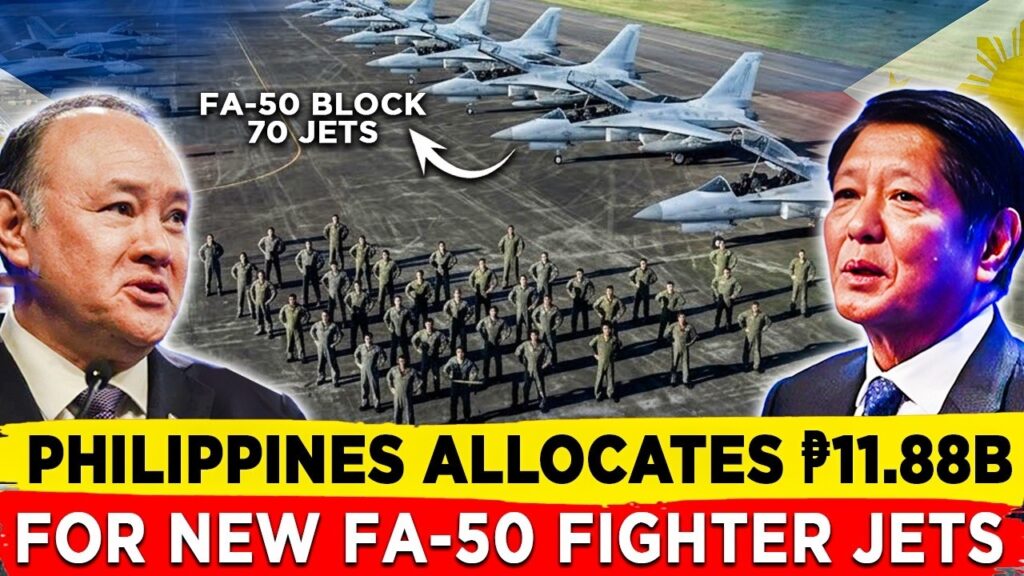
Philippines Allocates ₱11.88B for New FA-50 Block 70 Fighter Jets
What does ₱11.88 billion really buy in today’s world? A few highways? A handful of big infrastructure projects? Maybe. But in 2026, that same amount is being used by the Philippines to do something far more strategic, something that doesn’t just change budgets, but quietly reshapes how the country defends its skies.
New fighter jets. Not just any jets, but upgraded ones. Faster. Smarter. More capable of seeing threats before they even get close. And if you’re paying attention to what’s happening across the region, this move doesn’t feel random at all. Because here’s the thing people don’t always say out loud: air power is no longer optional. Not in Southeast Asia. Not anymore.
You can almost feel the shift. The South China Sea is getting more crowded, more watched, more tense. Ships are moving, aircraft are flying closer, surveillance is constant. It’s like everyone is waiting, watching, to see who has the edge. And for a long time, the Philippines didn’t.
If you go back to 2005, the country retired its last F-5 fighter jets. After that, there was, nothing. No supersonic air defense capability. For nearly a decade, Philippine airspace wasn’t defended by modern fighters at all. That’s not a small gap. That’s a huge one. It’s like locking your doors at night but leaving all the windows open.https://www.youtube.com/watch?v=f2hPOgAejfQ

Things started to change in 2014, when the Philippine Air Force brought in its first batch of FA-50 light combat aircraft from South Korea. Those jets weren’t perfect, but they mattered. They brought back speed. They brought back presence. They even saw real action during the Marawi crisis in 2017, proving they weren’t just for show.https://www.youtube.com/watch?v=f2hPOgAejfQ
But still, they were just the beginning. Now fast forward to today, and the government has approved ₱11.88 billion for new FA-50 Block 70 fighter jets. On paper, that might not sound massive compared to the billions larger countries spend. But context matters.
Indonesia and Australia Step Up Defense Ties with Jakarta Treaty Initiatives
Because this isn’t just another purchase. It’s an upgrade. A shift in capability. The FA-50 Block 70 isn’t the same aircraft that first arrived years ago. It’s smarter, sharper, more refined. It comes with improved radar systems, meaning it can detect targets earlier, sometimes significantly earlier. That alone changes how engagements play out. Think about it like this: in air combat, whoever sees first usually wins.
And that’s just the start. The Block 70 variant also carries better avionics, improved targeting systems, and enhanced electronic warfare capabilities. It can engage multiple targets more effectively. It’s more flexible. More survivable.
It’s still classified as a light combat aircraft, yes but it’s pushing closer to the edge of what that category can do. For the Philippines, that matters. Because right now, the goal isn’t to match major powers jet for jet. That’s unrealistic. The goal is something more practical, something more strategic. Credible deterrence.https://indopacificreport.com/gibo-teodoro-calls-for-urgent-upgrade-of-philippines-air-defense-systems/
That phrase gets used a lot, but what it really means is simple: having enough capability to make any potential threat think twice. Not to dominate the skies entirely but to make sure your skies aren’t easy to challenge. This new allocation also reflects something deeper: continuity.
The Philippines isn’t starting from scratch anymore. It’s building on what it already has. The existing FA-50 fleet will now be complemented by more advanced versions, creating a more capable and cohesive air wing. That matters for training too.https://www.youtube.com/watch?v=Kd8bU4iSPgs
Pilots don’t just fly aircraft, they grow with them. Moving from older variants to newer ones sharpens skills, improves coordination, and builds confidence. Over time, that creates a more professional, more capable force. But behind all this, there’s also a strategic partnership quietly doing a lot of work. South Korea.
Gibo Teodoro Calls for Urgent Upgrade of Philippines Air Defense Systems
The Philippines has developed strong defense ties with Seoul over the years, and this deal reinforces that relationship. It’s not just about buying jets, it’s about training, maintenance, and long-term support. That kind of partnership is important because modern fighter jets aren’t “buy and forget” systems. They require constant maintenance, upgrades, and technical expertise.
And that’s where things get a bit complicated. Because buying the jets is one thing, sustaining them is another. Advanced aircraft need infrastructure. Skilled technicians. Spare parts. Continuous funding. If any of those pieces fall short, readiness suffers.https://www.youtube.com/watch?v=Kd8bU4iSPgs
This is where critics start to raise valid concerns. Some argue that ₱11.88 billion could be used elsewhere, healthcare, education, infrastructure. And honestly, that’s a fair conversation. Every country has to balance defense with development. But here’s the counterpoint. Security underpins everything. Without secure airspace, without the ability to monitor and respond to threats, even economic growth becomes vulnerable. Trade routes, cities, infrastructure, all depend on stability.
And in a region where tensions are slowly rising, that stability can’t be taken for granted. There’s also the geopolitical angle. Every military upgrade sends a signal, whether intended or not. To allies, it signals commitment and seriousness. To potential adversaries, it signals capability. Sometimes reassurance. Sometimes warning. The Philippines strengthening its air force doesn’t automatically escalate tensions but it does change perceptions. It says: we are paying attention. We are preparing.
And that message carries weight, especially when combined with joint exercises like Balikatan, where interoperability with allies continues to improve. Still, the FA-50 Block 70 isn’t the final destination. It’s more like a stepping stone.
A bridge toward something bigger.https://www.youtube.com/watch?v=Kd8bU4iSPgs
Eventually, the Philippines is expected to move toward acquiring full multirole fighter jets, aircraft capable of deeper strike missions, stronger air superiority roles, and more advanced network integration. That’s where the real transformation happens. But you don’t jump there overnight.
You build toward it. Step by step. And this ₱11.88 billion investment? It’s one of those steps. A careful one. A calculated one. Looking ahead, there’s also the question of integration.
Modern warfare isn’t about isolated systems anymore. It’s about networks. Radar systems talking to aircraft. Aircraft linking with ground defenses. Data flowing in real time. If the Philippines can successfully integrate these new jets into a broader defense network, combining surveillance, missiles, and command systems, then their impact multiplies.https://www.youtube.com/watch?v=Kd8bU4iSPgs
If not, they risk becoming just standalone upgrades. And that’s the real challenge going forward. Not just buying capability but connecting it. Because at the end of the day, this isn’t just about jets. It’s about readiness.
It’s about making sure that when something unexpected happens, whether it’s a security incident, a crisis at sea, or an airspace violation, the response is fast, coordinated, and confident. And maybe that’s the biggest shift of all. For years, the Philippines was catching up. Rebuilding. Filling gaps. Now, it’s starting to move forward with intent. Not at the pace of global superpowers. Not with unlimited budgets. But with something just as important: direction. And in a region where the balance of power can shift quietly, sometimes direction is everything.https://youtu.be/tnZvnmBWcZ4?si=FVvAiVy5XiJyPUIs