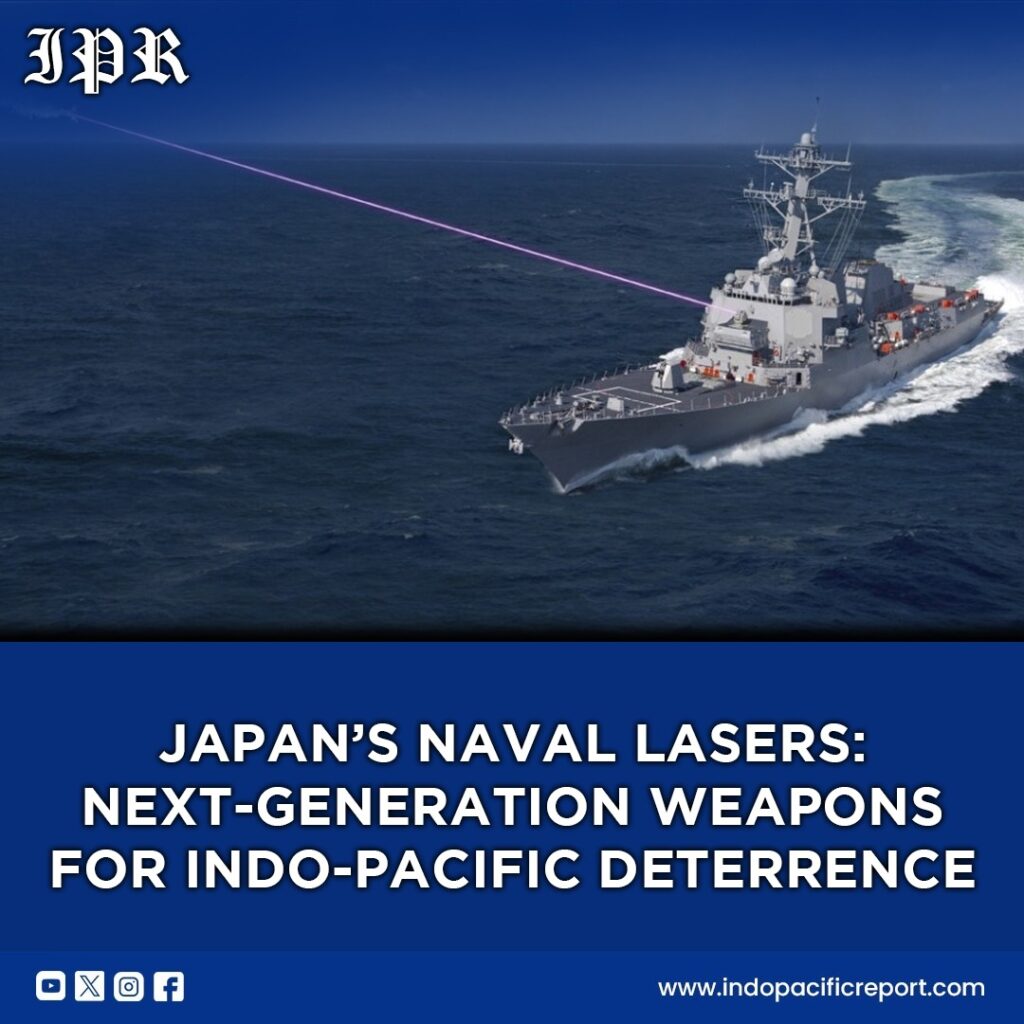
Japan has completed a series of shipboard laser trials aboard its experimental vessel JS Asuka and is now designing a new prototype high-energy laser system for its naval fleet. The trials, concluded in February 2026, evaluated system performance under real maritime conditions and provided critical data for refining targeting, fire-control, and shipboard integration technologies. This marks a significant step in Japan’s push toward next-generation directed-energy weapons.
From a great-power competition perspective, Japan’s development of high-energy naval weapons signals its intent to maintain a technological edge in maritime security. With China rapidly expanding its naval capabilities in the East and South China Seas, advanced shipboard lasers offer Japan a defensive advantage against swarming drones, small attack craft, and potentially ballistic or hypersonic threats. Such capabilities also strengthen deterrence by raising the operational cost for potential adversaries.
In the context of regional security architecture, laser-equipped ships could transform Japan’s maritime defense posture. By integrating precision high-energy weapons into the JMSDF, Japan enhances layered defense for key sea lanes in the East China Sea, the Strait of Taiwan, and the wider Indo-Pacific. This development complements ongoing efforts with allied navies, particularly the United States, to secure critical maritime corridors under the Free and Open Indo-Pacific framework.
Alliance dynamics are also affected. U.S.-Japan interoperability may benefit from Japan’s advances in directed-energy technology, which could be integrated with American sensor networks, missile defense, and fleet protection concepts. High-energy lasers, being modular and networkable, can serve as a force multiplier in joint operations while demonstrating Japan’s technological and industrial contribution to regional security.
From a maritime and technological strategy angle, the project reflects Japan’s focus on precision, modularity, and operational resilience. The laser system’s turret and containerized installation on JS Asuka indicate emphasis on environmental durability, stabilised targeting, and compatibility with existing ships. By moving from trials to a new prototype, Japan signals a commitment to scalable, shipboard-ready systems that could be deployed fleet-wide in the coming decade.
The broader Indo-Pacific balance of power implications are clear. Directed-energy weapons add a qualitative edge to Japan’s maritime defense and reinforce the technological dimension of deterrence. In a region defined by rapid naval modernization, laser systems provide both defensive capability and strategic signaling, underscoring Japan’s commitment to preserving freedom of navigation, protecting trade routes, and deterring coercion in contested waters.
Looking ahead, Japan’s high-energy laser program positions the JMSDF at the forefront of naval innovation. It strengthens deterrence against regional threats, supports alliance interoperability, and demonstrates how technological advancement can enhance maritime strategy without requiring massive fleet expansion. The program also signals to potential adversaries that Japan is preparing for the next era of naval warfare.
Audience question: Will high-energy naval weapons like lasers change the balance of power in the Indo-Pacific, or are they mainly a technological prestige project?
#IndoPacificSecurity #JapanMaritime #NavalInnovation #HighEnergyWeapons #DirectedEnergy #MaritimeDeterrence #GreatPowerCompetition #JMSDFCapabilities