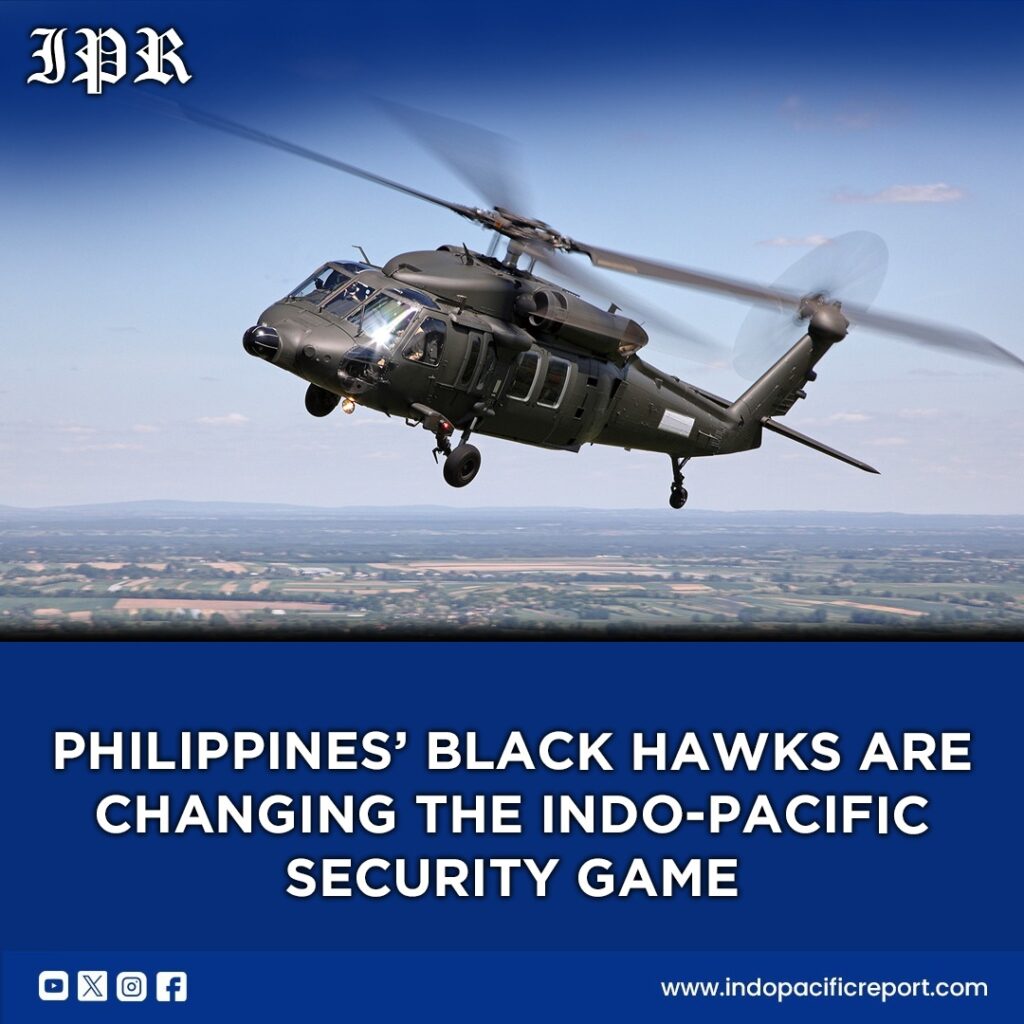
The Philippine Air Force (PAF) is set to receive the next batch of S-70i Black Hawk helicopters, with the first flight and testing phase already completed. Out of a total order of 32 units, 20 have been delivered, significantly boosting Manila’s air mobility, disaster response, and rapid operational deployment capabilities. The remaining helicopters are expected to arrive soon after final testing and acceptance procedures.
In the context of great-power competition, this acquisition is a strategic step. The Philippines sits at the frontline of the South China Sea, where Chinese maritime and aerial activity has grown steadily. The Black Hawks enable Manila to move forces quickly across its archipelago, respond to maritime incidents, and provide rapid humanitarian and military support, enhancing deterrence against coercion.
From a regional security architecture perspective, these helicopters improve interoperability with US forces, Japan, and other ASEAN partners. They allow the Philippines to participate in joint exercises, including island defense, search-and-rescue, and maritime security drills. This strengthens Manila’s position within the US-Philippines Mutual Defense Treaty framework and builds trust with regional allies.
In terms of alliance dynamics, the Black Hawks are widely used among US and allied forces. Standardization makes training, logistics, and technical support simpler, allowing the Philippines to integrate more effectively into multilateral operations. Manila’s modernization signals that it is investing in credible defense capability, not just relying on external security guarantees, which may influence the calculations of regional powers.
Looking at maritime strategy, the helicopters enhance the Philippines’ ability to patrol and assert control over its archipelagic waters and exclusive economic zones. Rapid deployment across islands and maritime chokepoints improves sovereignty enforcement, protects trade routes, and supports maritime law enforcement—all critical in the resource-rich and contested waters of the South China Sea.
Strategically, these helicopters contribute to the Indo-Pacific balance of power. While China continues to expand its naval and missile capabilities, the Black Hawks increase Manila’s operational resilience. Even without large-scale offensive capabilities, enhanced air mobility allows the Philippines to respond faster, support allied operations, and raise the costs for potential aggressors, reinforcing regional deterrence.
Forward-looking assessment: The S-70i Black Hawk deliveries are more than a fleet upgrade—they mark a shift toward operational readiness and allied integration. As the Philippines continues modernizing its air and naval forces, its growing mobility and rapid-response capability strengthen deterrence and deepen ties with regional security partners.
Audience Question: Can the Philippines’ Black Hawk helicopters really change the strategic balance in the South China Sea, or are they only a small part of a larger deterrence equation?