Indonesia Military Advantage Over the Philippines – 2026 Update
Have you ever wondered what would actually happen if two Southeast Asian nations with long coastlines, thousands of islands, and strategic positions suddenly had to rely only on their own military strength? Imagine this for a second. A crisis erupts somewhere in Southeast Asia. Shipping lanes become tense. Naval patrols multiply overnight. Fighter jets begin circling above disputed waters. In that moment, one question quietly becomes very important: who actually has the stronger military capability to respond quickly and decisively?
That question has come up more often lately when analysts compare Indonesia and the Philippines. Both are major maritime nations. Both sit in extremely strategic locations. And both are modernizing their militaries. But when you look closely at the numbers, the structure of their forces, and the technologies they are developing, a clear picture begins to emerge. Indonesia, in 2026, holds a noticeable military advantage over the Philippines. The difference isn’t just about weapons. It’s about geography, strategy, logistics, industry, and long-term planning. Let’s start with geography, because in military strategy, geography often decides everything before a single ship leaves port.

Indonesia is enormous. When people look at a map, they sometimes underestimate just how massive the country actually is. Stretching more than 5,000 kilometers from west to east and consisting of over 17,000 islands, Indonesia sits right between the Indian and Pacific Oceans. It literally sits on top of some of the busiest shipping lanes on Earth. The Strait of Malacca, the Sunda Strait, and the Lombok Strait all pass through Indonesian territory or lie directly next to it. These waterways carry huge portions of global trade every day.https://www.youtube.com/watch?v=ciSNHLochbs
Because of this geography, Indonesia doesn’t just defend its territory, it influences global maritime traffic. Ships traveling between Asia, the Middle East, Europe, and Africa often pass near Indonesian waters. The Philippines is also an archipelago, with around 7,600 islands, but the strategic situation is slightly different. Its geography is more concentrated and heavily exposed to the South China Sea and the Luzon Strait, two areas where geopolitical tension can rise quickly. Natural disasters like typhoons also affect military readiness in ways that Indonesia experiences less frequently.

So from the start, Indonesia’s geography gives it a broader strategic footprint. Its islands spread across multiple seas and straits, allowing its military to operate across a wider area and influence more maritime routes. But geography alone doesn’t win battles. Military structure matters even more.https://indopacificreport.com/philippines-vs-indonesia-a-military-comparison/
Indonesia’s armed forces, known as the Tentara Nasional Indonesia (TNI), are significantly larger and more complex than those of the Philippines. As of 2026, Indonesia maintains roughly 400,000 active military personnel. That includes a large army, a growing navy, and an increasingly modern air force.
The Indonesian Army remains the backbone of the country’s defense. It has mechanized brigades, armored vehicles, artillery units, and a territorial command structure spread across the entire archipelago. This system allows Indonesia to deploy forces quickly across many islands while maintaining internal stability.
The Philippines, by comparison, fields about 125,000 active troops. Much of its army is structured around light infantry units designed for territorial defense, disaster response, and counterinsurgency operations. Mechanization exists, but at a much smaller scale.
This difference in structure reflects two very different strategic histories. Indonesia built its military to manage a massive archipelago and respond to multiple security threats simultaneously. The Philippines, on the other hand, historically focused on internal security and relied more heavily on alliances, particularly with the United States, for external defense.https://youtu.be/jfFRSyrh1UA?si=eD_J-uv3pKY2NDGT
The naval balance tells an even clearer story. Indonesia’s navy operates more than 130 ships, including submarines, frigates, corvettes, amphibious assault ships, and patrol vessels. Its submarine fleet includes advanced Type 209 and Type 214 designs, capable of stealth operations in deep waters and chokepoints.
Submarines are important because they are one of the most powerful deterrent tools a country can have. A single submarine, hidden beneath the sea, can change how an entire naval force behaves.https://youtu.be/jfFRSyrh1UA?si=eD_J-uv3pKY2NDGT
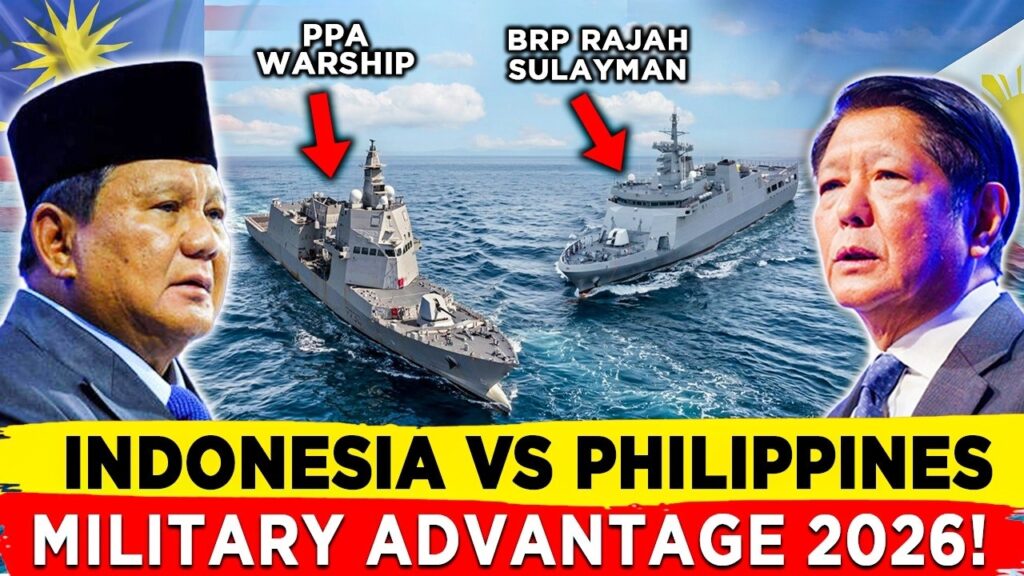
The Philippine Navy, meanwhile, operates roughly 50 ships, many of which are patrol vessels or logistical support ships. In recent years, the Philippines has begun modernizing its fleet with new frigates and offshore patrol vessels, but the overall size and capability gap remains significant. You could think of it this way: Indonesia fields a navy designed for regional influence, while the Philippine Navy is still evolving toward that level.
Philippines vs Indonesia The Race for Dominance in Southeast Asia
Air power also shows a noticeable gap. Indonesia operates advanced fighter aircraft including F-16s and Su-27/30 fighters, and it is also participating in the KF-X/IF-X next-generation fighter program with South Korea. This project aims to produce a modern multirole jet that could significantly strengthen Indonesia’s air capabilities in the coming decade.https://youtu.be/jfFRSyrh1UA?si=eD_J-uv3pKY2NDGT
The Philippine Air Force has made progress, especially with the introduction of FA-50 light fighter jets, but its fleet remains relatively small. For many years after retiring its old F-5 fighters, the Philippines had no true supersonic fighter capability at all. Rebuilding that capability takes time.
Technology and industry also play a surprisingly big role in this comparison. Indonesia has spent years developing a domestic defense industry. Companies like PT Pindad, PT PAL, and PT Dirgantara Indonesia manufacture armored vehicles, naval vessels, and aircraft components. This means Indonesia can produce and maintain some of its own military equipment without depending entirely on foreign suppliers.
That independence matters during long-term conflicts or political crises. A country that can manufacture parts and weapons domestically has more flexibility. The Philippines does not yet have the same level of defense industrial capacity. Most of its major military platforms come from partners such as the United States, South Korea, or Japan. While those partnerships are valuable, reliance on imports can slow modernization and limit long-term autonomy.https://www.youtube.com/watch?v=ciSNHLochbs\
Then there’s logistics, the quiet, often invisible backbone of military power. Indonesia has invested heavily in moving troops and equipment across its massive archipelago. Transport aircraft like the C-130 Hercules and CN-235, combined with naval transport ships, allow Indonesian forces to shift units quickly between islands.
In 2025, Indonesia conducted a large exercise known as Armada Jaya, where forces were deployed across eight islands within just a few days. Exercises like this demonstrate something extremely important: operational mobility. The Philippines faces more logistical constraints. Its islands are spread out and its transport fleet is smaller. Rapid deployment across the entire archipelago can be challenging, especially during emergencies. This doesn’t mean the Philippines lacks capability. It means the scale of operations Indonesia can sustain is simply larger.
Indonesia-Vietnam Building a Blue Economy and Smart Urban Future
Another interesting factor is diplomatic flexibility. Indonesia has cultivated defense partnerships with many countries at once, the United States, Australia, Japan, South Korea, and others. It participates actively in multinational exercises while maintaining a policy of strategic independence.
The Philippines has a very strong alliance with the United States under the Mutual Defense Treaty, which provides powerful security backing. But reliance on one major ally sometimes limits strategic independence compared to Indonesia’s diversified approach.
When global analysts rank military strength, these differences become visible in international indexes. In the 2026 Global Firepower ranking, Indonesia is placed around 16th in the world, while the Philippines ranks significantly lower.https://www.youtube.com/watch?v=90wAGcpvyag’
Numbers like that don’t tell the whole story, of course. Military power isn’t just about ranking charts. It’s about readiness, training, doctrine, and leadership. Even Indonesia has limitations. Its defense budget, while larger than the Philippines’, still trails far behind the budgets of major Asian powers like China, Japan, or India. Procurement processes can sometimes move slowly, and maintaining security across 17,000 islands is an enormous challenge.
But despite those obstacles, Indonesia’s military trajectory is clear. It is steadily modernizing, expanding its capabilities, and strengthening its domestic defense industry. The Philippines is also modernizing, but its transformation is happening from a smaller base. Many of its current efforts focus on coastal defense, maritime patrol, and strengthening alliances. So when analysts compare the two in 2026, Indonesia emerges with advantages in several key areas: force size, naval strength, defense industry, logistics, and geographic reach.https://www.youtube.com/watch?v=jfFRSyrh1UA
Yet the story isn’t about rivalry. Both countries are members of ASEAN, and both benefit from regional stability. Their militaries increasingly participate in exercises together, building trust and cooperation. Still, in strategic terms, the balance of capability matters.
In a region where sea lanes carry trillions of dollars in trade and geopolitical tensions sometimes flare unexpectedly, the ability to deploy forces quickly and independently can shape the outcome of crises before they even begin. And right now, when you look across Southeast Asia’s complex maritime landscape, Indonesia’s military posture gives it a noticeable edge.https://youtu.be/VGB2imzawKk?si=ODLl73Yau56ITlfT