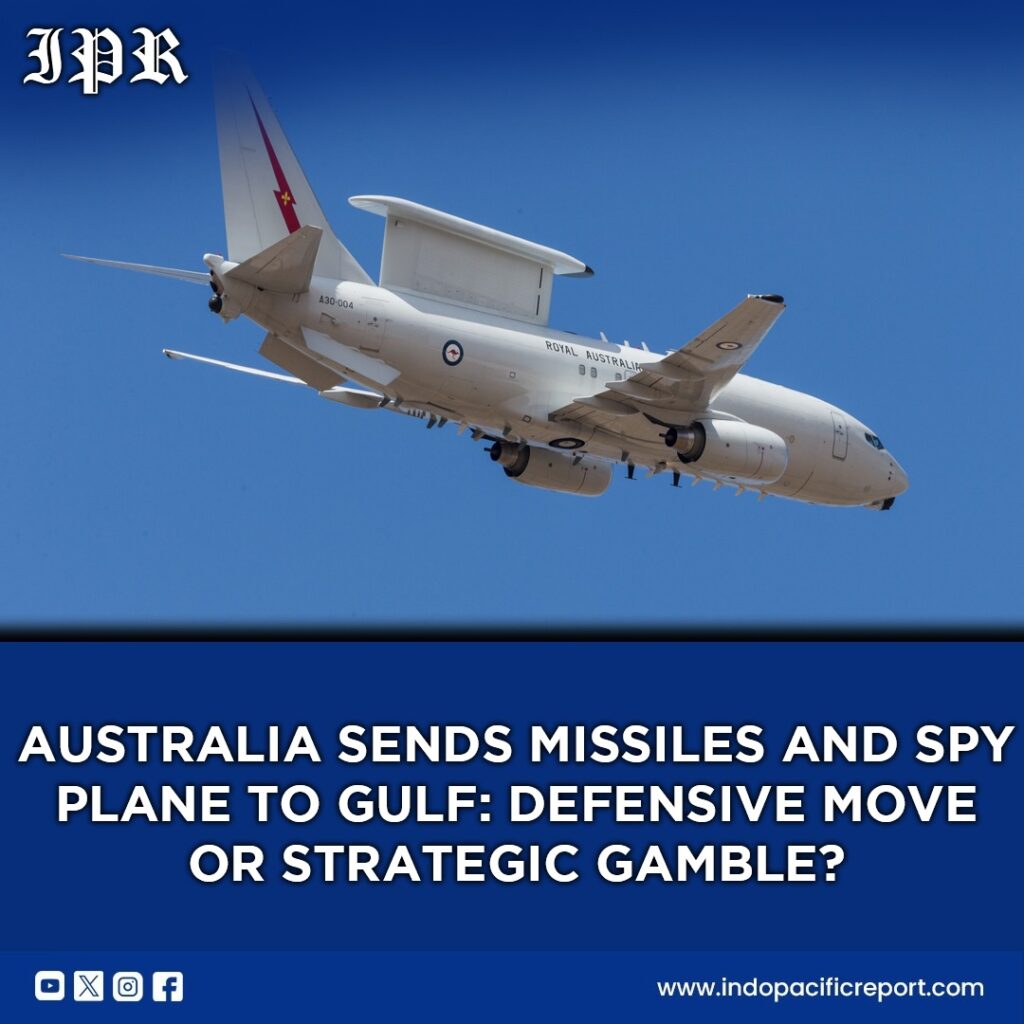
Australia’s recent decision to deploy air-to-air missiles and a long-range E7A Wedgetail reconnaissance aircraft to the Gulf reflects a calculated move to bolster regional deterrence while protecting its nationals and allies. Prime Minister Anthony Albanese framed the deployment as strictly defensive, emphasizing that Canberra is not engaging in offensive operations against Iran and is not sending ground troops. With over 115,000 Australians in the region, including 24,000 in the UAE, the move is designed to ensure rapid response capabilities for civilian protection, while also signaling solidarity with Gulf partners.
Viewed through the lens of great-power competition, Australia’s deployment complements U.S. efforts to counter Iranian aggression, while subtly positioning Canberra as a reliable partner capable of contributing beyond traditional Pacific security commitments. The inclusion of advanced air-to-air missiles and a surveillance platform strengthens integrated regional air defense networks, enhancing situational awareness and rapid threat response for Gulf allies, particularly the UAE. This also demonstrates Australia’s willingness to project limited but sophisticated military power far from its immediate neighborhood, which resonates in Indo-Pacific strategic calculations.
From a regional security architecture perspective, Australia’s contribution underscores the evolving collective defense dynamic in the Middle East, where multiple states—including France, the UK, and other European allies—are deploying forces to ensure freedom of navigation and civilian protection. Canberra’s actions reinforce multilateral security coordination in the Gulf, particularly in response to Iran’s escalating drone and missile attacks. By integrating into an allied air defense network, Australia strengthens deterrence while signaling that regional escalation will meet coordinated defensive responses.
Alliance dynamics are also at play. Australia’s cooperation with the UAE follows high-level consultations and phone calls between Albanese and President Mohammed bin Zayed Al Nahyan. The move aligns Canberra with broader Western strategic objectives, particularly U.S.-led initiatives in the Gulf, while allowing Australia to exercise independent operational judgment. However, the deployment has drawn domestic criticism from political opponents, who warn that even defensive deployments risk entangling Australia in a protracted regional conflict—a reminder of the domestic constraints that shape expeditionary military policy.
On the maritime and economic strategy front, Australia’s deployment indirectly supports the protection of global energy routes, particularly the Strait of Hormuz, through which a significant share of world oil and gas passes. By enhancing air surveillance and intercept capabilities, Canberra contributes to maintaining open shipping lanes, a critical factor for both Gulf economies and energy-importing Indo-Pacific states, including Japan, South Korea, and India. The deployment highlights the intersection of military defense, economic security, and the broader strategic calculus of ensuring uninterrupted trade flows in a contested region.
Implications for the Indo-Pacific balance of power are notable. Australia’s willingness to project airpower into the Gulf signals a broader approach to global security responsibilities, extending its influence beyond the Pacific. This could strengthen Canberra’s standing among allies while signaling to China and other regional powers that Australia is willing and capable of supporting coalition operations in critical maritime corridors. It also raises questions about the future role of middle powers in global crisis response and the limits of national military capacity in managing far-flung contingencies.
Forward-looking assessment: Australia’s deployment represents a careful balancing act between defensive military engagement, alliance coordination, and domestic political constraints. While Canberra’s contribution enhances deterrence and collective security in the Gulf, it also positions Australia as an actor with global operational reach, capable of integrating into multinational responses to strategic crises. Future developments will hinge on the trajectory of Iranian actions, the level of coalition cohesion, and the domestic appetite in Australia for sustained engagement in distant theaters of conflict.
Debate Question:
Will Australia’s defensive deployments in the Gulf strengthen Indo-Pacific security, or risk entangling Canberra in conflicts far beyond its strategic interests?