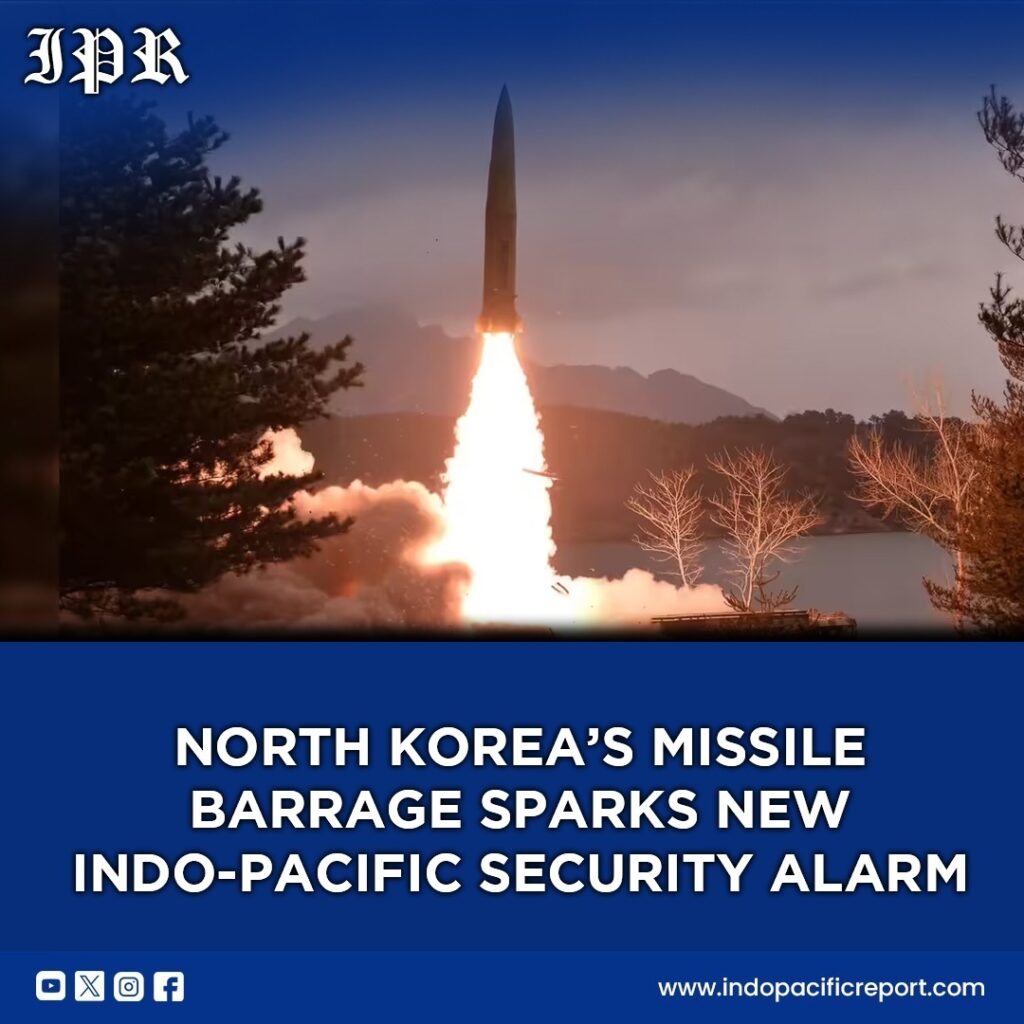
North Korea’s recent test of 10 ballistic missiles from its upgraded KN-25 multiple rocket launcher system underscores the accelerating pace of Pyongyang’s conventional and tactical missile development. The missiles, fired from the Western District Long-Range Artillery Unit, traveled roughly 340–360 kilometers before impacting an island target in the Sea of Japan. While state media frames the exercise as routine, the timing—coinciding with the U.S.-South Korea Freedom Shield 26 joint exercises—demonstrates Pyongyang’s strategic intent to signal both capability and deterrence. This test blurs the line between multiple rocket launcher systems and short-range ballistic missiles, reflecting North Korea’s drive to diversify its strike options and complicate allied defensive planning.
In terms of great-power competition, North Korea continues to function as a strategic wild card in the U.S.-China-Russia triangular balance. While the missile test does not directly challenge Beijing or Moscow, it forces Washington and Seoul to maintain elevated readiness along the Korean Peninsula. These launches serve multiple purposes: they reassure domestic and regional constituencies of the regime’s defensive resolve, while testing allied surveillance, tracking, and missile defense systems. Pyongyang’s assertion that these drills demonstrate the destructive potential of tactical nuclear weapons adds a layer of strategic signaling that magnifies anxiety across the region.
The test also highlights the importance of regional security architecture in Northeast Asia. Japan, South Korea, and the United States rely on layered missile defense systems, early warning networks, and joint operational planning to deter or respond to missile threats. North Korea’s increased precision, range, and volume of fire challenge these architectures, pressuring allies to accelerate modernization, integrate sensors, and ensure interoperability. By launching multiple missiles simultaneously, North Korea tests the robustness of early-warning systems, the capacity of missile interceptors, and the command-and-control coordination among allied forces.
Alliance dynamics are central to interpreting the broader implications. The Freedom Shield 26 exercises, conducted concurrently with the North Korean launches, reaffirm the U.S.-ROK alliance’s ability to operate jointly across domains. These maneuvers underscore the political and operational message that an attack on South Korea will meet a coordinated response, while also deterring miscalculation by Pyongyang. However, repeated provocations strain the alliance’s signaling: South Korea and Japan must calibrate responses carefully to maintain credibility without escalating tensions inadvertently.
From a maritime and economic strategy perspective, North Korea’s missile developments have indirect but meaningful implications. The Sea of Japan and surrounding waters are vital commercial corridors for Northeast Asia, linking Japan, Korea, and Russia to global markets. Increasing missile ranges and launch capabilities introduce risk into these maritime routes, compelling regional navies to integrate missile defense and monitoring platforms more deeply into commercial traffic protection strategies. The militarization of nearby waters can influence insurance, shipping logistics, and regional economic confidence, further demonstrating how tactical military developments ripple into economic stability considerations.
The broader balance of power in the Indo-Pacific is subtly reshaped by Pyongyang’s continued missile testing. While North Korea remains a secondary actor compared to China or the U.S., its capacity to conduct precision strikes across the Korean Peninsula and the Sea of Japan imposes operational and strategic constraints on allies. These launches force sustained investments in missile defense, rapid response capabilities, and joint planning across the U.S.-Japan-ROK triangle. Moreover, North Korea’s demonstrations contribute to an environment where ambiguity and miscalculation are constant risks, intensifying strategic competition in Northeast Asia.
Looking forward, North Korea’s evolving missile arsenal reinforces the need for resilient, multi-layered defense and deterrence strategies. Allies must continue integrating early-warning systems, mobile and layered interceptors, and joint operational planning to absorb shocks from both conventional and nuclear-capable missile threats. Simultaneously, political signaling, crisis management mechanisms, and regional diplomatic engagement remain essential to prevent escalation while maintaining credible deterrence. Pyongyang’s KN-25 tests are not isolated events; they are strategic instruments that shape decision-making, operational readiness, and long-term regional posture across the Indo-Pacific.