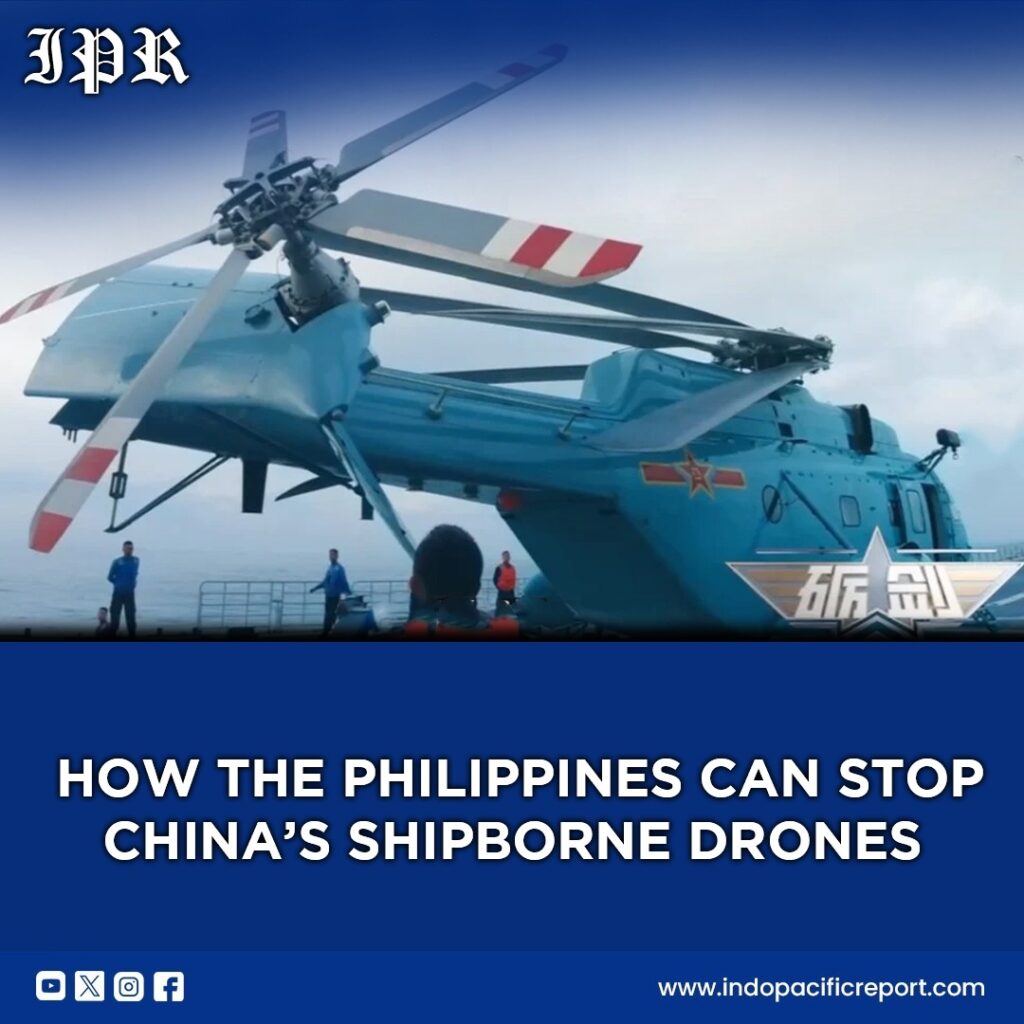
China’s deployment of shipborne autonomous helicopters on its Type 075 amphibious assault ships is a new challenge for the Philippines. These drones give the PLA enhanced surveillance, reconnaissance, and potentially targeting capabilities in contested waters. While the drones themselves are small and unarmed for now, they act as force multipliers for China’s larger naval presence. For Manila, deterring this capability will require a mix of technology, alliances, and operational strategy.
First, developing counter-drone capabilities is essential. Small unmanned aircraft can be tracked, jammed, or even neutralized using electronic warfare (EW) systems. Coastal radar stations and shipborne sensors can help detect drone operations early. Anti-drone systems, including directed-energy weapons or net/capture technologies for UAVs, could also be integrated on Philippine ships and coastal facilities. Even inexpensive countermeasures can complicate PLA drone operations and force China to allocate more resources to protect them.
Second, alliances and partnerships play a key role. The Philippines can work with the United States, Japan, and Australia to gain access to advanced sensors, electronic warfare tools, and shared intelligence on drone movements. Joint naval exercises can include counter-UAV scenarios, allowing regional navies to practice identifying, tracking, and responding to autonomous threats. Such alliances multiply deterrence, as China would face coordinated surveillance and possible interference across multiple fronts.
Third, maritime awareness and layered surveillance are critical. Shipborne drones rely on being able to operate in contested waters without interference. By improving coastal radar, maritime patrol aircraft, and unmanned surface or underwater vehicles, the Philippines can create a multi-layered detection network. Even simple measures like drone patrols over key sea lanes or contested features can complicate PLA operations and force Chinese drones to operate at greater risk.
Fourth, asymmetric and distributed naval tactics can strengthen deterrence. Small, fast patrol boats armed with anti-drone systems, along with networked communications to share real-time targeting and sensor data, allow the Philippines to operate in a decentralized but coordinated manner. This makes it harder for China to rely solely on drones to dominate certain maritime zones. Layered defenses, combined with mobility and unpredictability, reduce the operational advantage that autonomous systems provide.
Finally, investing in diplomacy and signaling can reinforce these technical and operational measures. Manila can work with ASEAN partners and international forums to highlight PLA drone operations in the South China Sea, framing them as destabilizing and coercive. Publicizing countermeasures and exercises sends a clear message: autonomous systems will not give China uncontested control. In geopolitical terms, signaling is part of deterrence—it raises the potential cost of Chinese operations without direct confrontation.
In short, deterring China’s shipborne drones is not about matching them one-to-one. It is about combining technology, alliances, layered surveillance, operational flexibility, and strategic signaling. By doing so, the Philippines can preserve operational space, protect its sovereignty, and complicate Beijing’s gray-zone coercion.
Question for readers:
Can the Philippines realistically deter China’s naval drones without relying entirely on the U.S. military?