Power often breeds confidence. But in geopolitics, confidence without restraint can quickly turn into strategic overreach. The unfolding crisis in the Middle East suggests that the U.S. President Donald Trump may have stepped into precisely such a trap—one that now threatens not only regional stability but also the credibility of American power.
The chain of events arguably began far from the Persian Gulf, in Latin America. In January 2026, the United States carried out an unprecedented military operation in Venezuela that resulted in the capture of Venezuelan President Nicolás Maduro and his transfer to U.S. custody. The operation, involving coordinated strikes and special forces, was widely criticized by legal scholars and international observers as a violation of sovereignty and international law.
Yet the operation succeeded in its immediate objective. Washington demonstrated its ability to remove a hostile leader with overwhelming force and minimal domestic cost. For the Trump administration, it appeared to validate a doctrine of coercive unilateralism: decisive military action could reshape political realities abroad without prolonged conflict.
That perception of success may have emboldened Washington to escalate pressure elsewhere—particularly against Iran.
Over the past months, the Trump administration intensified its campaign against Tehran, moving significant military assets into the Middle East and issuing sweeping demands regarding Iran’s regional posture and nuclear activities. Tehran was pressured to accept a set of conditions that effectively amounted to strategic capitulation. Negotiations were intermittently discussed, and Iran signaled some willingness to engage diplomatically.
But before diplomacy could meaningfully unfold, events took a dramatic turn.
In Early-March, U.S. forces launched major airstrikes on Iranian military infrastructure, including targets around Kharg Island, one of Iran’s most strategically important energy and military hubs in the Persian Gulf. The strikes reportedly destroyed dozens of facilities linked to naval operations and missile systems.
The expectation in some quarters of Washington was that overwhelming force would produce a familiar outcome: shock, deterrence, and perhaps reluctant Iranian compliance.
Instead, Tehran responded immediately—and forcefully.
Iran launched a wave of retaliatory strikes across the region, targeting U.S. and allied positions and expanding the battlefield beyond a bilateral confrontation. Missile and drone attacks were reported against multiple Gulf states, while American installations in Iraq also came under fire.
More consequentially, Iran leveraged its greatest strategic card: geography.
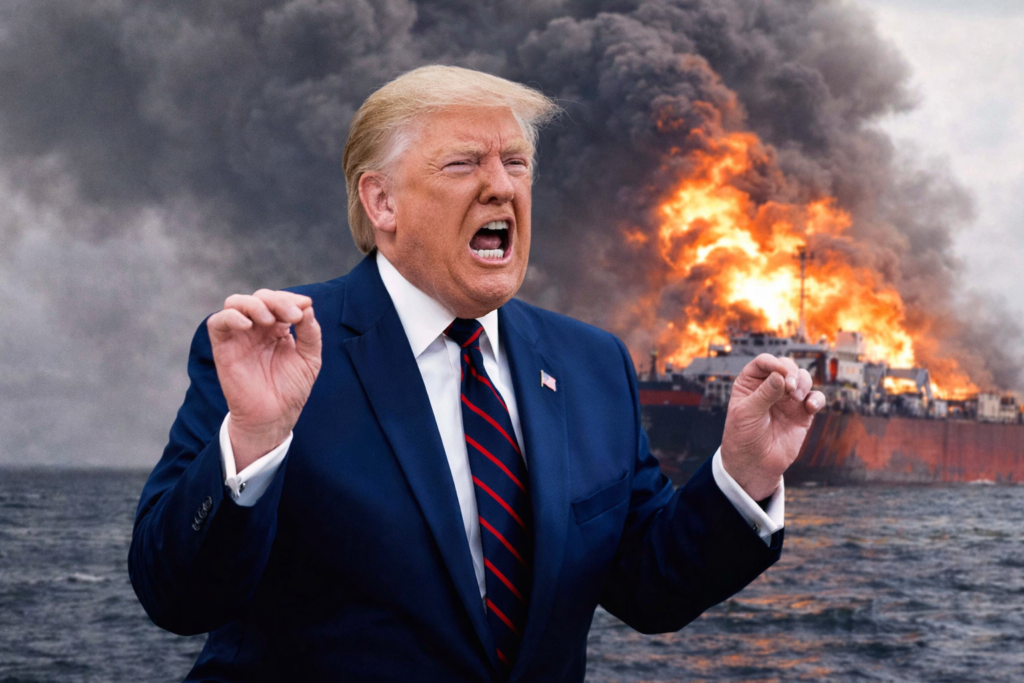
Tehran effectively shut down the Strait of Hormuz, the narrow maritime passage through which roughly one-fifth of global oil supply flows. By threatening shipping lanes and positioning naval assets in the region, Iran transformed a regional military confrontation into a global economic crisis. Oil prices surged and energy markets were thrown into turmoil as tankers avoided the waterway.
The war’s regional ripple effects have been equally dramatic. Gulf states—many of which had hoped to remain outside the direct line of fire—have been drawn into the conflict’s periphery. Infrastructure sites and ports across the region have reported attacks, highlighting how rapidly escalation can spread once hostilities begin.
In Israel, Iranian missile barrages have tested the limits of defensive systems designed to intercept ballistic threats. Even advanced missile defense architectures can be strained by sustained and complex attacks.
What began as a show of force has now evolved into a multi-front strategic crisis.
Faced with the disruption of the Strait of Hormuz and mounting regional instability, Washington has turned to its allies for assistance. President Trump has urged several countries—including Britain, Japan, and others dependent on Gulf energy—to deploy naval forces to secure the vital shipping corridor.
So far, the response has been cautious at best.
Several key allies have hesitated to commit military assets without a clearer strategic framework. Some governments fear being drawn into a widening war, while others question whether reopening the strait through force could trigger even greater escalation.
This reluctance highlights a broader challenge for American leadership: unilateral decisions often demand multilateral consequences. When partners feel excluded from the decision to initiate a conflict, they are less inclined to share its burdens.
The strategic dilemma facing Washington now is stark.
To reopen the Strait of Hormuz by force would require a sustained naval campaign against Iranian capabilities along the Gulf—a move that risks deepening the conflict. Yet leaving the strait contested allows Tehran to maintain enormous leverage over global energy markets and regional security.
Neither option promises a quick or decisive resolution.
For decades, American strategy in the Middle East rested on deterrence, coalition-building, and carefully managed escalation. The current confrontation reflects a departure from that model—one where rapid military action preceded diplomatic consensus and long-term planning.
History offers many examples of powerful nations misjudging the limits of coercion. The Middle East, with its complex alliances and asymmetric strategies, has often humbled even the most formidable militaries.
Today’s crisis appears to be another reminder of that reality.
The United States entered the confrontation expecting swift results and manageable retaliation. Instead, it faces a widening regional conflict, strained alliances, disrupted global energy markets, and an adversary willing to escalate asymmetrically.
In short, the strategic balance has shifted from decisive action to strategic entanglement.
And that is why, in the eyes of many observers, the current situation can be summed up in a single uncomfortable conclusion: the United States—and Donald Trump in particular—may have bitten off more than it can chew.