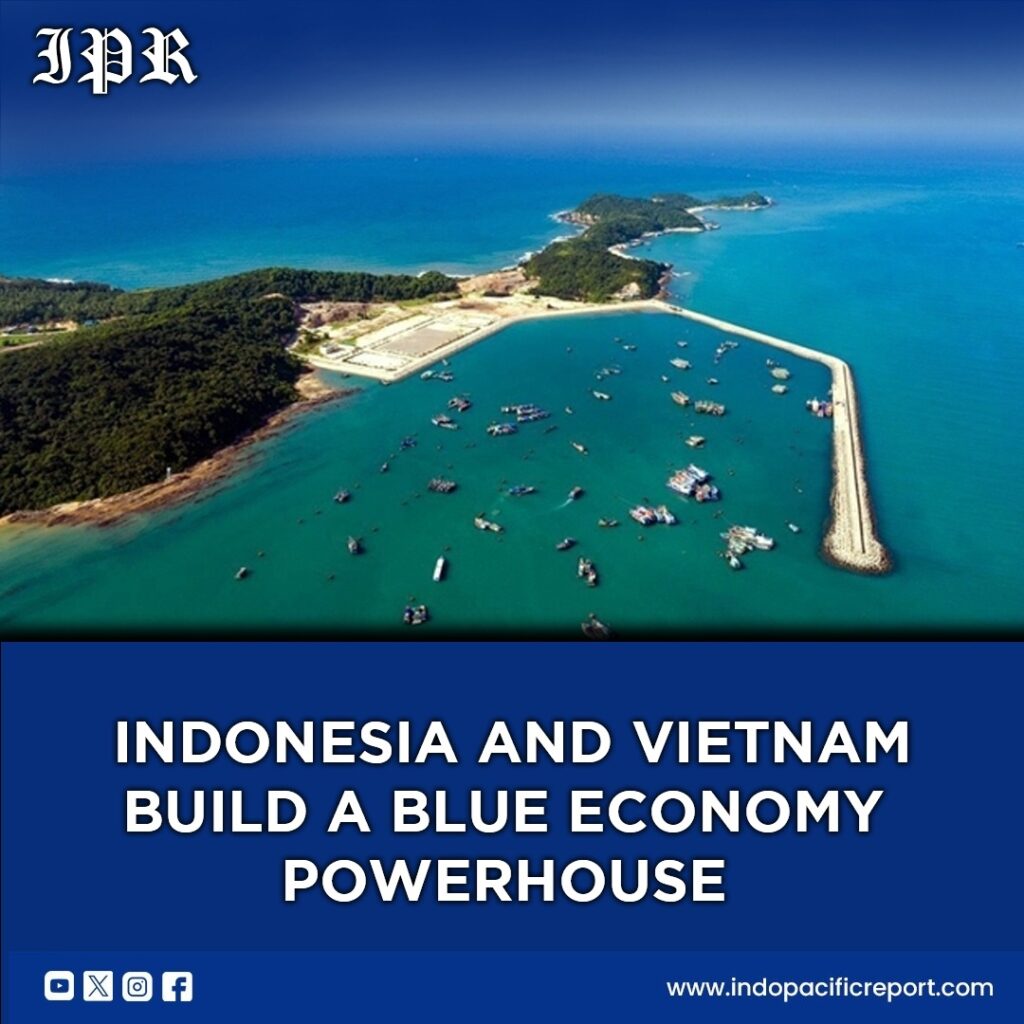
Indonesia and Vietnam are deepening their strategic partnership, focusing on the maritime economy, fisheries, and urban development. Indonesia controls one of the world’s largest marine territories, but its fleets and infrastructure need modernization. Vietnam has efficient industrial processing and export systems but limited fishing grounds. By combining strengths, the two nations are aiming to become a regional Blue Economy hub.
From a great-power competition perspective, this partnership is a statement of Southeast Asian agency. While the U.S. and China compete for influence in the Indo-Pacific, Indonesia and Vietnam are building capabilities independently. Controlling fisheries, aquaculture, and industrial supply chains gives both nations leverage and strengthens their strategic autonomy.
In regional security terms, cooperation on maritime resources matters. Joint efforts on aquaculture, floating net cages, and combating illegal, unreported, and unregulated (IUU) fishing improve monitoring and enforcement across the seas. Coordinated fleets and port operations allow both nations to better protect vital sea lanes and maritime resources, enhancing stability in the South China Sea and neighboring waters.
The partnership also reshapes alliance dynamics. While not a military alliance, it builds mutual trust, shared standards, and coordinated economic strategy. Hanoi and Jakarta signal that ASEAN middle powers can act independently, managing regional challenges without being fully dependent on Washington or Beijing. This is a subtle but important strategic message.
Beyond the ocean, the partnership addresses urbanization and economic resilience. Indonesia is building its new capital, Nusantara (IKN), while Vietnam expands high-tech industrial zones. Sharing expertise in urban planning, “Smart City” frameworks, and housing can help both countries manage rapid urban growth, reduce poverty, and enhance social stability. Civilian infrastructure becomes intertwined with national resilience and strategic capability.
Implications for the Indo-Pacific By combining maritime resources, industrial know-how, and urban planning, Indonesia and Vietnam strengthen their middle-power influence. They can shape regional security and economic trends, contribute to maritime stability, and hedge against great-power coercion. Their cooperation is a model of regional autonomy, showing how ASEAN states can act strategically in a complex Indo-Pacific.
Forward-looking assessment The Indonesia-Vietnam partnership is more than trade—it is a blueprint for regional self-reliance. By leveraging marine wealth and industrial expertise, both nations increase resilience, protect economic interests, and enhance their influence in the Indo-Pacific. Their joint initiatives may inspire other ASEAN countries to pursue similar strategic collaborations.
Audience Question for Debate Can ASEAN middle powers like Indonesia and Vietnam truly shape regional maritime security independently, or will great-power rivalry always dominate