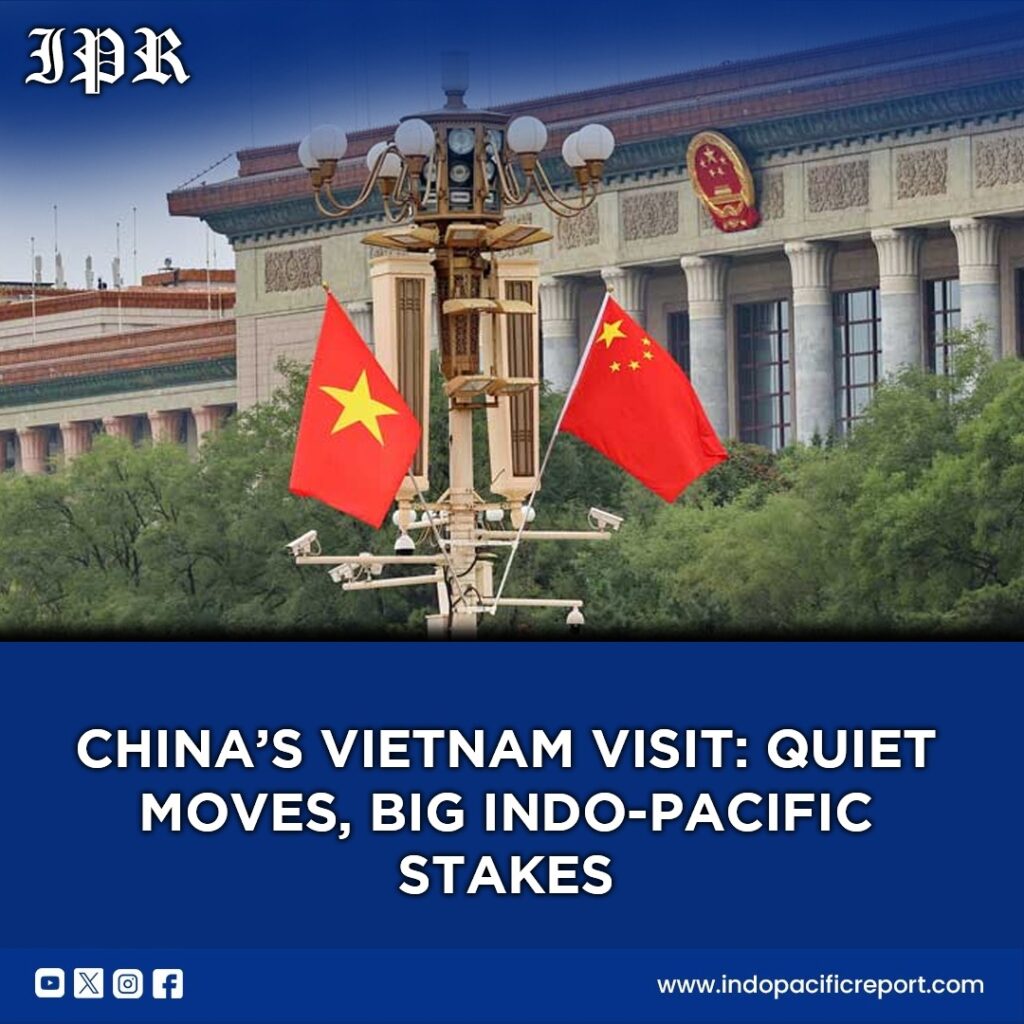
China’s foreign minister Wang Yi and defence minister Dong Jun are visiting Vietnam this weekend to strengthen political and security ties. They will meet Vietnamese counterparts to discuss defence, joint maritime patrols, law enforcement, and regional security issues. This visit comes as Hanoi balances close economic ties with Beijing against concerns about China’s assertiveness in the South China Sea.
On the surface, this looks like routine diplomacy. But strategically, Beijing is using the visit to deepen influence without confrontation. By emphasizing cooperation and shared stability, China positions itself as a reliable partner in a region unsettled by shifting U.S. policies and past trade tensions. For Vietnam, engaging China brings economic benefits and security assurances, but it also risks being pulled deeper into China’s strategic orbit.
From a great-power competition perspective, this visit shows China’s approach of using diplomacy to expand influence. Agreements on AI, supply chains, railway projects, and maritime cooperation are not just economic deals—they are tools to extend China’s reach, integrate Vietnam into its strategic networks, and secure influence over key maritime corridors.
In terms of regional security architecture, high-level engagement strengthens China’s presence in Southeast Asia without direct military confrontation. Joint patrols and defence coordination give Beijing more visibility and influence over operations in nearby waters. Even small agreements shift the balance of maritime awareness and risk perception in China’s favor, making it harder for other powers to challenge its regional strategy.
Alliance dynamics are also at play. Vietnam has security ties with the United States and participates in regional multilateral frameworks. China’s outreach tests these alliances by offering incentives that make dependence on Beijing more attractive. The question is whether Hanoi can maintain its strategic autonomy while cooperating with China—or whether it will be forced to favor one side in great-power competition.
Economically, China’s deals with Vietnam serve its maritime and strategic goals. Ports, supply chains, and infrastructure projects increase Beijing’s influence over trade routes and maritime logistics. These civilian projects double as strategic leverage, linking economic cooperation with regional power projection.
Implications for the Indo-Pacific: The visit highlights China’s “quiet power” strategy. Influence is built incrementally, through cooperation, agreements, and shared projects, while maintaining plausible deniability. Over time, these moves can shift regional perceptions and alter the balance of power, subtly reinforcing China’s dominance in Southeast Asia.
Forward-looking assessment: China’s Vietnam visit shows that power in the Indo-Pacific is as much about diplomacy and networks as it is about military assets. Regional states and U.S. allies must track these small moves carefully, as they cumulatively shape deterrence, alliances, and maritime norms in ways that could favor Beijing.
Audience Question for Debate: Can Vietnam cooperate with China without undermining its security ties with the U.S., or is strategic dependence inevitable?