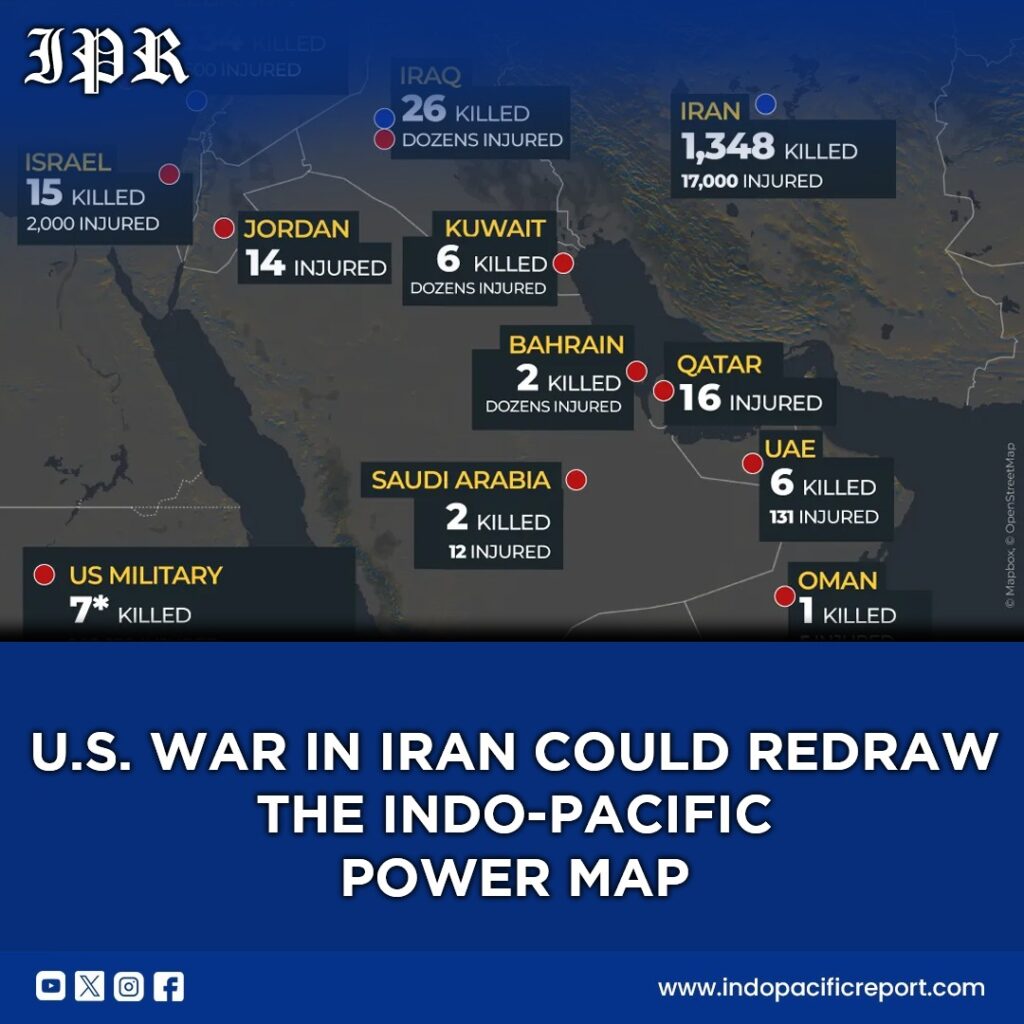
The U.S.-led war in Iran is already reshaping perceptions of American reliability across Asia. For decades, Washington has presented itself as the guarantor of security in the Indo-Pacific, supporting allies like South Korea, Japan, Taiwan, and the Philippines against Chinese coercion and North Korean threats. Yet the urgent redeployment of advanced air defenses—including THAAD batteries from South Korea—and the diversion of carrier strike groups to the Middle East underscores a simple reality: America’s strategic attention is finite. Allies are now questioning whether U.S. commitments to Asia can withstand competing crises elsewhere. This recalibration has immediate implications for alliance credibility and deterrence in the region.
From a great-power competition perspective, China stands to gain both materially and psychologically. As U.S. forces are stretched, Beijing can signal that it is the region’s more reliable power. Already, Chinese state media is exploiting rising oil prices and economic strain in Asia to reinforce narratives of American overreach and decline. Militarily, while Chinese activity around Taiwan has remained cautious, construction and dredging in the Paracels and South China Sea continue, demonstrating Beijing’s capacity to advance territorial and maritime objectives while U.S. attention is elsewhere. For China, this is a window to consolidate power incrementally without provoking full-scale confrontation.
The diversion of U.S. assets exposes vulnerabilities in the regional security architecture. Asia’s current defense networks depend heavily on American equipment, munitions, and intelligence. Patriot missiles, THAAD interceptors, and other precision systems have limited stockpiles; rapid consumption in the Middle East has created gaps. Japan and Taiwan face delayed arms deliveries, while South Korea confronts reduced defensive coverage. These shortfalls underscore the fragility of current alliance structures: when the U.S. is engaged in another theater, the region’s defensive posture is weakened. The result is a strategic dilemma for middle powers, who must either accept higher vulnerability or invest in autonomous military capabilities.
Economic and maritime dimensions are intertwined with these security concerns. Rising oil prices caused by the Iran war directly impact Asian manufacturing powerhouses. Over 90% of Japanese oil passes through the Strait of Hormuz, while other Indo-Pacific economies are similarly dependent on uninterrupted energy flows. Strategic vulnerability to energy supply shocks can amplify China’s influence, as Beijing leverages its growing regional presence and stable domestic energy reserves. Simultaneously, maritime assertiveness in the South China Sea continues unabated, as regional actors calculate that U.S. strategic bandwidth is temporarily constrained.
The current crisis is also accelerating indigenous military-industrial development in Asia. Japan is pursuing long-range missile capabilities, while South Korea moves to deploy nuclear-powered submarines. Taiwan is rethinking force posture and procurement priorities. A long-term implication is the emergence of a more diversified Indo-Pacific defense ecosystem, less dependent on U.S. hardware alone. While this may enhance regional resilience, it also risks accelerating a localized arms race, increasing the potential for miscalculation or accidental escalation in disputed zones.
Looking forward, the U.S. will need to restore confidence among Indo-Pacific partners or risk ceding strategic space to China. The war in Iran is a stress test: if the United States cannot maintain credible deterrence in Asia while engaged elsewhere, Beijing may feel emboldened, and middle powers may adopt hedging strategies, including self-reliant defense programs and closer ties with China. The Indo-Pacific balance of power is shifting subtly but perceptibly. The crisis highlights the critical importance of adaptable alliances, resilient supply chains, and a realistic assessment of U.S. global commitments.
Audience Question: If the U.S. is distracted elsewhere, should Indo-Pacific nations accelerate military self-reliance or double down on alliances with Washington?