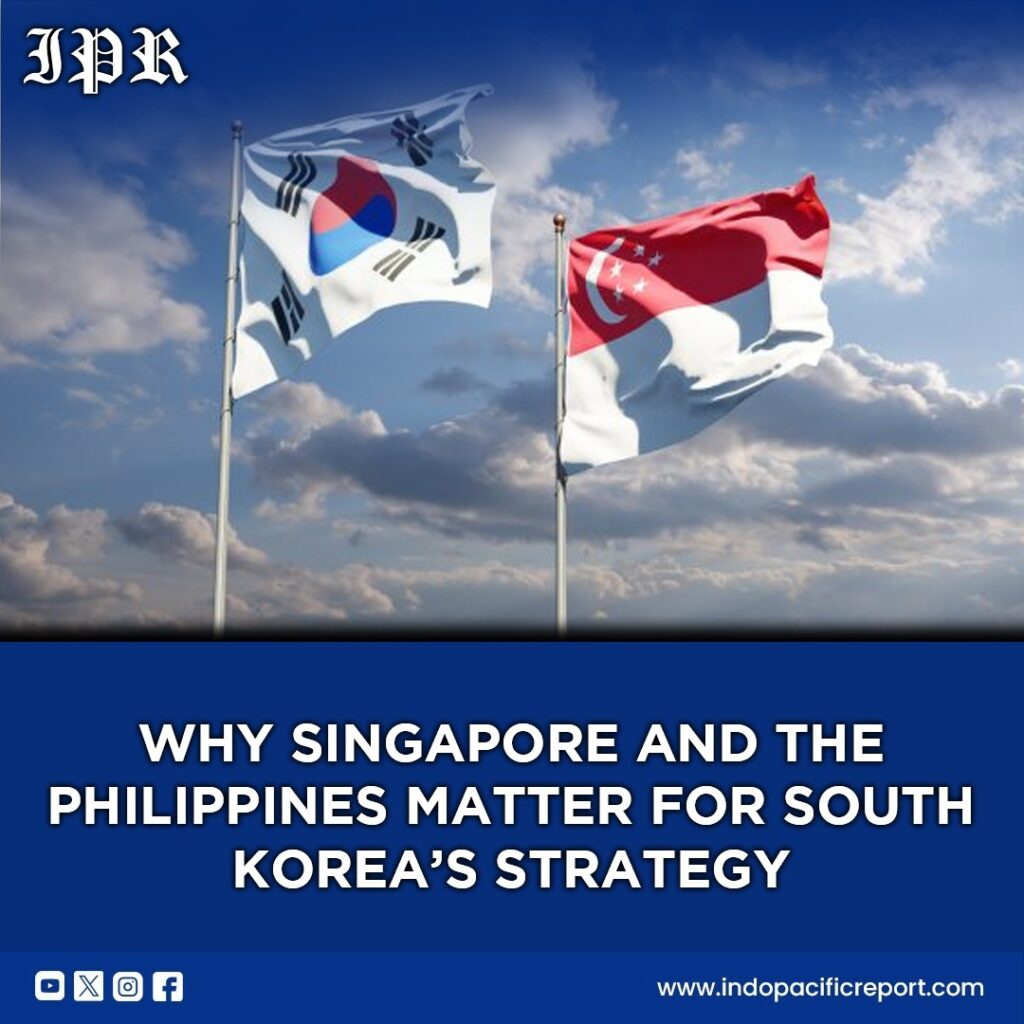
South Korean President Lee Jae Myung’s three-night state visit to Singapore and the Philippines reflects more than diplomatic routine. It highlights the growing strategic importance of Southeast Asia in the broader Indo-Pacific balance of power. In an era defined by technological competition, maritime tensions, and shifting supply chains, South Korea’s outreach to ASEAN partners demonstrates how middle powers are expanding their geopolitical footprint beyond traditional alliances. Meetings with Singaporean Prime Minister Lawrence Wong and other regional leaders focused on cooperation in artificial intelligence, nuclear energy, and economic partnerships—areas that increasingly define power and influence in the twenty-first century. Behind these discussions lies a deeper strategic calculation: South Korea seeks to position itself as a key technological and economic partner for Southeast Asia while reinforcing the regional architecture that underpins Indo-Pacific stability.
From the perspective of great-power competition, Seoul’s diplomatic engagement with ASEAN members illustrates the widening geopolitical contest across the Indo-Pacific. The United States and China remain the dominant strategic actors, but middle powers like South Korea are increasingly shaping the regional order through economic statecraft and technology diplomacy. By strengthening ties with Singapore and the Philippines, Seoul expands its strategic reach into a region where maritime security, digital infrastructure, and supply chains intersect. These partnerships allow South Korea to diversify its economic and diplomatic relationships while contributing to a broader coalition of states that favor an open and rules-based regional system. In practice, this engagement complements the strategic priorities of Washington while maintaining Seoul’s own autonomy in navigating relations with Beijing.
The visit also underscores the evolving regional security architecture of the Indo-Pacific. Southeast Asia occupies the geographic crossroads between the Pacific and Indian Oceans, making it a critical arena for strategic competition. Singapore acts as a financial and technological hub with deep connections to global trade networks, while the Philippines serves as a frontline maritime state facing persistent tensions in the South China Sea. By engaging both countries during a single diplomatic mission, Seoul signals its recognition that economic development and maritime security are increasingly interconnected. Cooperation with Singapore on emerging technologies such as artificial intelligence reflects the strategic importance of digital innovation, while engagement with the Philippines strengthens links with a key security partner in maritime Southeast Asia.
Alliance dynamics further shape the significance of this trip. South Korea remains a treaty ally of the United States, and its regional diplomacy increasingly aligns with Washington’s Indo-Pacific strategy. However, Seoul has also pursued its own initiatives to deepen relations with Southeast Asia, reflecting a broader effort to reduce overdependence on any single geopolitical axis. Strengthening ties with Singapore and the Philippines allows South Korea to embed itself more deeply within ASEAN networks, which function as one of the region’s most important diplomatic platforms. These partnerships contribute to a flexible security environment where cooperation occurs through overlapping relationships rather than rigid alliances. Such a networked approach increases deterrence by complicating the strategic calculations of potential adversaries while preserving diplomatic flexibility.
Economic strategy forms another key pillar of the visit. Southeast Asia has become one of the fastest-growing digital and manufacturing markets in the world. As global supply chains shift and technological competition intensifies, partnerships in areas such as artificial intelligence, advanced manufacturing, and energy infrastructure carry increasing strategic weight. South Korea’s discussions on AI cooperation with Singapore and its broader engagement with ASEAN reflect an effort to position Korean industries within the region’s emerging digital ecosystem. Meanwhile, collaboration in nuclear energy and advanced technologies highlights Seoul’s ambition to export high-value industrial capabilities. These economic initiatives strengthen regional connectivity while reinforcing South Korea’s role as a technological middle power within the Indo-Pacific.
The geopolitical significance of this visit ultimately lies in how it reflects the growing agency of middle powers in shaping the regional order. For decades, Indo-Pacific geopolitics was largely defined by the strategic rivalry of major powers. Today, however, states such as South Korea, Singapore, and the Philippines are increasingly shaping the region’s trajectory through networks of economic, technological, and security cooperation. These partnerships help create a more distributed balance of power, where influence is shared among multiple actors rather than concentrated in a single hegemon. In this environment, diplomacy becomes a tool not only for bilateral cooperation but also for shaping the strategic architecture of the wider region.
Looking ahead, South Korea’s engagement with Southeast Asia is likely to deepen as geopolitical competition intensifies. The convergence of maritime security concerns, digital transformation, and economic integration will continue to draw Seoul closer to ASEAN partners. If sustained, these relationships could strengthen the resilience of the Indo-Pacific order by linking technological innovation with regional stability. At the same time, they highlight a broader trend: the future balance of power in the Indo-Pacific will increasingly depend on the strategic choices of middle powers that connect the region’s economic dynamism with its evolving security landscape.