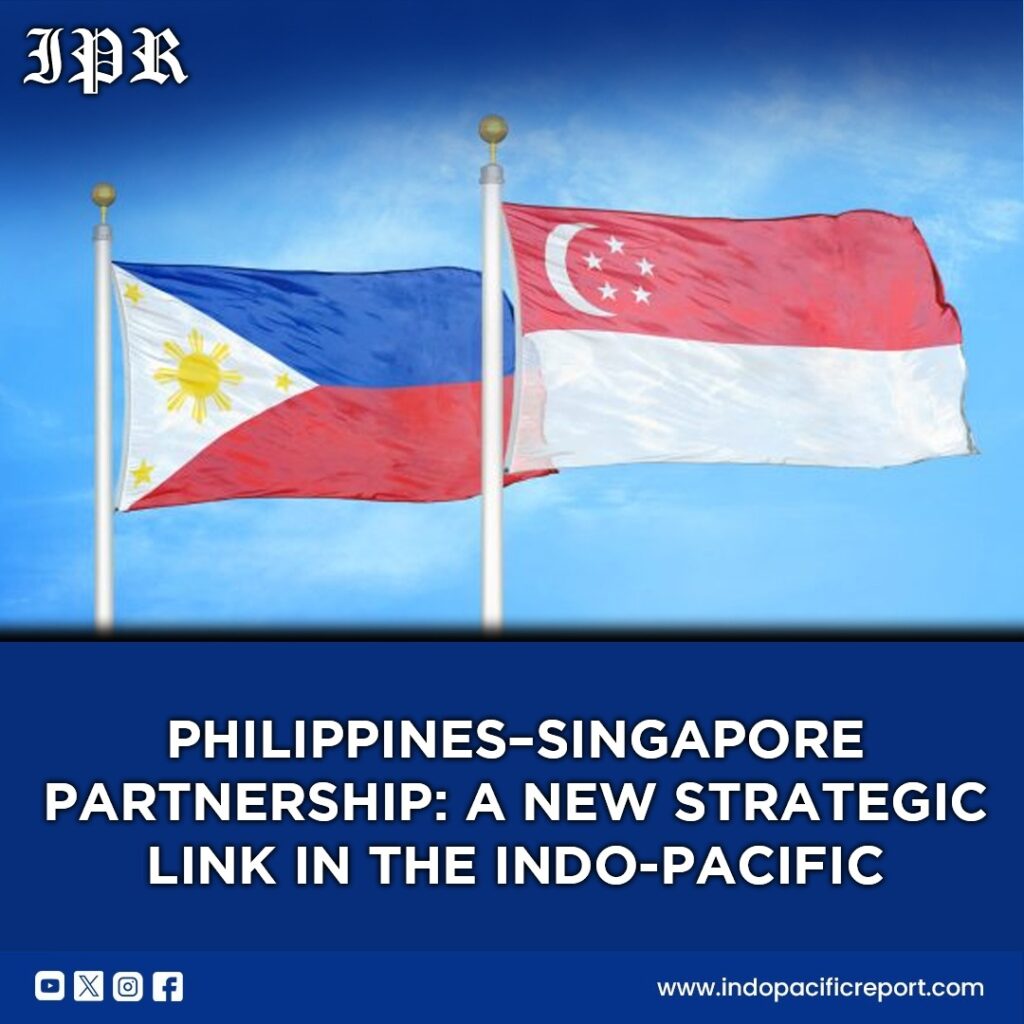
The meeting between Philippine President Ferdinand Marcos Jr. and Singapore’s Deputy Prime Minister Gan Kim Yong at Malacañang Palace signals more than routine diplomacy between two Southeast Asian states. It reflects a broader strategic adjustment unfolding across the Indo-Pacific as regional actors strengthen internal partnerships amid intensifying great-power competition. The Philippines and Singapore occupy very different geographies and strategic roles—one an archipelagic frontline state in the South China Sea, the other a global financial hub at the crossroads of maritime trade—but their growing cooperation highlights how middle powers are quietly shaping the region’s evolving security architecture.
At the level of great-power politics, closer Philippines–Singapore ties reflect the increasingly complex balancing behavior of Southeast Asian states between the United States and China. Manila has moved closer to Washington in recent years, expanding defense cooperation and reinforcing deterrence in response to tensions with Beijing in disputed waters. Singapore, meanwhile, has traditionally pursued a strategy of strategic neutrality while maintaining strong defense links with the United States and deep economic ties with China. Cooperation between Manila and Singapore therefore represents a form of regional hedging: strengthening intra-ASEAN partnerships to preserve autonomy in an environment defined by the growing rivalry between Beijing and Washington. Such moves do not create formal alliances, but they strengthen the strategic resilience of the region’s middle powers.
From a regional security perspective, the Philippines and Singapore play complementary roles within the evolving architecture of Southeast Asian stability. The Philippines is increasingly a security actor at the maritime frontier, confronting gray-zone pressure in the South China Sea and strengthening its naval and coast guard capabilities. Singapore, by contrast, operates as a strategic connector—hosting multinational military training, facilitating financial flows, and acting as a diplomatic bridge between competing powers. Cooperation between the two therefore links frontline maritime security with institutional and economic capacity. This alignment enhances the ability of Southeast Asian states to respond collectively to regional disruptions, even as the Association of Southeast Asian Nations (ASEAN) struggles to maintain unity on contentious issues such as maritime disputes.
Alliance dynamics also form an important layer of the strategic significance of this engagement. The Philippines is a formal treaty ally of the United States, and its defense posture increasingly reflects Washington’s broader Indo-Pacific strategy. Singapore, while not a treaty ally, maintains close defense cooperation with the United States, including access arrangements for American forces and regular joint exercises. When Manila and Singapore strengthen cooperation, they indirectly reinforce a wider network of U.S.-aligned partnerships across maritime Southeast Asia. This network operates less like a rigid alliance bloc and more like a flexible lattice of security relationships. In practice, such a structure increases deterrence by complicating the strategic calculations of potential challengers while avoiding the political backlash that formal alliance expansion might provoke.
Economic and maritime strategy further explain the logic behind deepening cooperation. The Philippines sits astride key sea lines connecting the western Pacific to Southeast Asia, while Singapore controls one of the world’s most important maritime chokepoints near the Strait of Malacca. Both countries depend heavily on stable maritime trade flows. Any disruption in the South China Sea or surrounding waters would directly affect their economic security. Strengthened bilateral engagement can therefore be interpreted as part of a broader effort to safeguard regional supply chains, digital connectivity, and maritime infrastructure. For Singapore, deeper economic and logistical engagement with the Philippines opens new investment and connectivity opportunities. For Manila, partnership with a financial and technological hub like Singapore supports economic modernization while reducing vulnerability to geopolitical pressure.
The broader implication is that Southeast Asia is slowly developing a more layered and interconnected security landscape. Instead of relying solely on major powers or multilateral institutions, regional states are building a dense web of bilateral and minilateral partnerships. These networks strengthen resilience against coercion and provide alternative pathways for cooperation when ASEAN consensus becomes difficult. In this sense, the Philippines–Singapore relationship reflects a larger trend across the Indo-Pacific: middle powers are not passive spectators in great-power rivalry. They are active architects of the region’s strategic equilibrium.
Looking ahead, the deepening of ties between Manila and Singapore may also influence the wider Indo-Pacific balance of power. As tensions in the South China Sea persist, frontline states like the Philippines will continue seeking partnerships that enhance deterrence and maritime awareness. Meanwhile, economically advanced states like Singapore will remain central nodes in regional connectivity and security dialogue. Their cooperation thus strengthens the broader strategic fabric linking maritime Southeast Asia with the Indo-Pacific system. If sustained, such partnerships could gradually reinforce a rules-based regional order by distributing strategic capacity among multiple states rather than concentrating it in the hands of a few major powers.
In the long term, the significance of the Marcos–Gan meeting lies not in immediate policy outcomes but in the signal it sends. Southeast Asian states are preparing for a prolonged era of geopolitical competition. By strengthening ties with each other, they aim to maintain strategic autonomy while shaping the evolving balance of power in their favor. The future of Indo-Pacific stability may therefore depend as much on the quiet diplomacy of regional middle powers as on the grand strategies of global superpowers