Can the Philippines Hold the First Island Chain? America’s Real Test of Deterrence
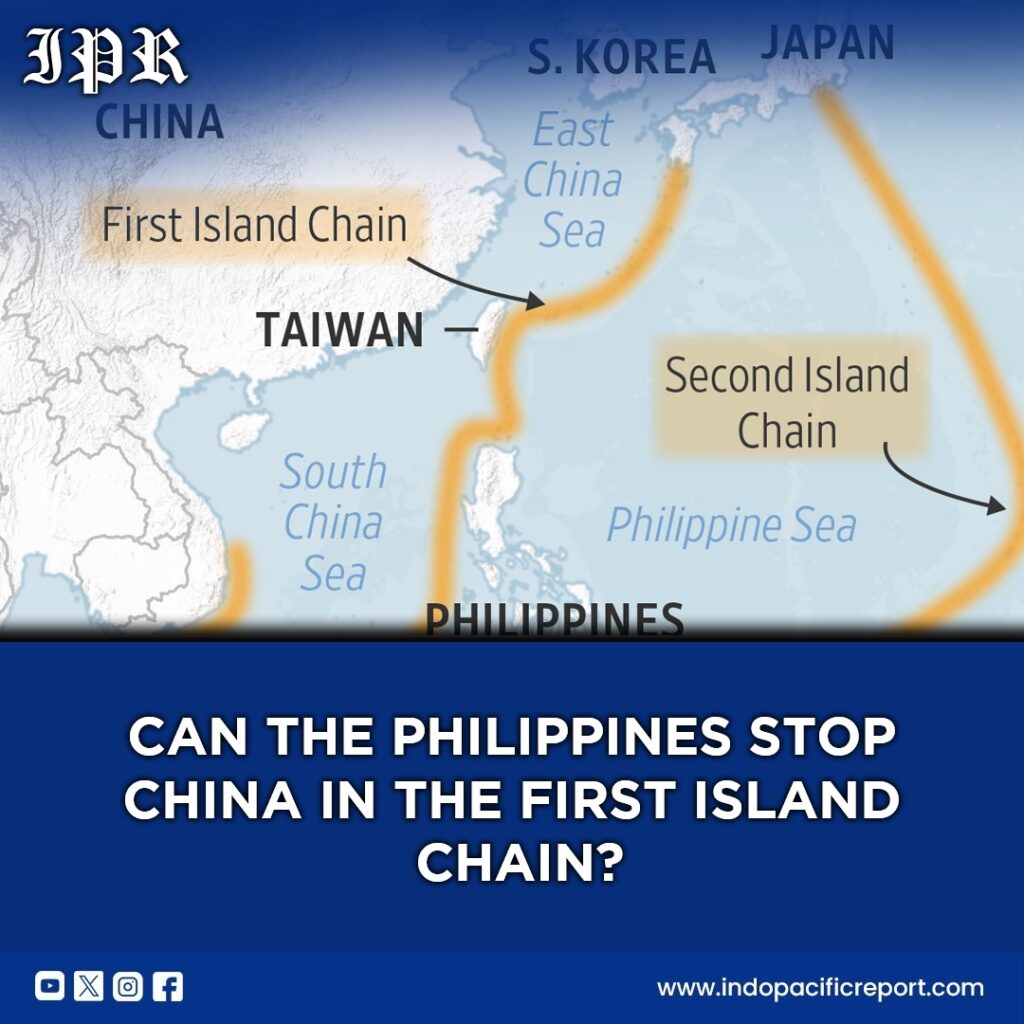
The United States’ latest defense strategy emphasizes deterrence by denial in the Indo-Pacific. Instead of responding after an adversary seizes ground, the goal is to prevent control in the first place. For the U.S., this means stopping China from quickly dominating key sea lanes and airspace. In this strategy, the Philippines is critical. Its location along the Luzon Strait and the Bashi Channel puts it at the center of the First Island Chain, a frontline barrier against Chinese expansion in the Western Pacific.
Geography makes the Philippines strategically vital. Northern Luzon and Palawan lie close to contested waters in the South China Sea. Control over these routes could determine the outcome of a crisis. U.S. and allied forces operating from Philippine territory can complicate Chinese attempts to dominate the region. If Manila cannot maintain secure and resilient bases, the effectiveness of the entire First Island Chain strategy is undermined.
The alliance structure has evolved to support this strategy. The 1951 Mutual Defense Treaty provides the legal framework for security cooperation. After the closure of U.S. bases in 1991, agreements such as the Visiting Forces Agreement (1998) and the Enhanced Defense Cooperation Agreement (2014) allowed rotational U.S. deployments, infrastructure upgrades, and prepositioning of equipment—without permanent bases. These “places, not bases” arrangements balance military utility with Philippine sovereignty.
Operational resilience is now the key measure of credibility. Modern threats like precision missile strikes, cyberattacks, and electronic warfare can quickly disable fixed facilities. Deterrence depends on distributed logistics, rapid repair, and redundant communications, not just the number of troops or aircraft. Runways, ports, and storage facilities must remain functional even under attack to make the alliance meaningful.
In practical terms, Philippine deterrence relies on four pillars: maritime domain awareness, mobile coastal defense, dispersed logistics, and rapid repair. Surveillance and intelligence networks allow both Philippine and allied forces to detect threats. Mobile coastal defenses increase costs for any aggressor. Distributed supply lines and quick repair ensure operations can continue under pressure. Together, these elements make the Philippines a resilient node in the First Island Chain.
Politics adds another layer of complexity. U.S. military presence has always been sensitive in Manila. Domestic support fluctuates with leadership and public opinion. Former President Duterte challenged the alliance framework, showing how political swings can affect operational credibility. Today, Manila emphasizes sovereignty, defensive missions, and humanitarian roles alongside deterrence. A strategy is only effective if it can survive democratic debate and leadership changes.
Gray-zone threats further test this resilience. China has increased maritime pressure using harassment, ramming, and water cannons. Cyber operations and disinformation campaigns are also likely. U.S. and Philippine forces must maintain credibility without escalating conflicts. Ambiguity or miscommunication in alliance signaling could be exploited. Manila’s focus on distributed, Philippine-owned capabilities helps reduce political and operational risks while strengthening deterrence.
The Philippines’ approach, called the Comprehensive Archipelagic Defense Concept, focuses on resilient, sovereign, and distributed defense capabilities. Hardened infrastructure, dispersed bases, prepositioned equipment, and rapid repair systems are at its core. This ensures that deterrence is not symbolic but operational and sustainable. Manila’s credibility in a crisis will depend on its ability to maintain these systems under pressure.
In the long term, geography ensures the Philippines will remain central to Indo-Pacific strategy. But politics will determine whether its potential translates into real deterrence. The First Island Chain can only hold if Manila combines resilient infrastructure, operational readiness, and domestic legitimacy.
Audience question:
Can the Philippines balance domestic politics and alliance obligations to remain a credible First Island Chain partner, or will political swings weaken deterrence?