How China Took Over Mischief Reef – Can the Philippines Stop It?
Every day, thousands of ships quietly pass through the South China Sea. Oil tankers, container ships, bulk carriers, the arteries of global trade. Economists estimate that more than $3.4 trillion worth of commerce moves through these waters every single year, linking factories in East Asia with markets in Europe and energy suppliers in the Middle East. It’s one of those places most people rarely think about, yet the global economy would stumble without it.
Now imagine this. You’re sailing through these open waters and suddenly a question hits you: what if a small reef, barely visible above the sea a few decades ago, quietly turned into a military outpost that could monitor, even influence, one of the busiest shipping lanes on Earth?
That’s exactly the story of Mischief Reef. Today, satellite images show long runways, fortified structures, radar systems, and deep-water facilities where fishermen once anchored their boats. But the transformation didn’t happen overnight. It unfolded slowly, almost quietly at first, a handful of structures here, a patrol there, a construction project that grew larger year by year. By the time the world fully realized what was happening, the reef had effectively become a strategic stronghold for China.https://www.youtube.com/watch?v=uzL8fy-tDQ4

And here’s the twist that makes the situation even more complicated. Mischief Reef sits well within the 200-nautical-mile exclusive economic zone claimed by the Philippines under the rules of the United Nations Convention on the Law of the Sea. In legal terms, that should give Manila certain sovereign rights over the area’s resources and activities. But in reality, control on the water often depends less on legal arguments and more on ships, infrastructure, and power projection.
That’s why the reef has become such a sensitive flashpoint. It sits inside the wider Spratly Islands, a scattered chain of reefs, shoals, and tiny islands claimed by several governments including China, the Philippines, Vietnam, Malaysia, Taiwan, and Brunei. For decades these claims simmered in diplomatic statements and occasional patrol encounters. But as energy resources, fisheries, and strategic sea lanes gained importance, the competition intensified.
China’s claim, marked by the controversial Nine‑Dash Line, stretches across much of the South China Sea and overlaps with the maritime zones of several Southeast Asian states. Critics argue that the claim contradicts modern maritime law, while Beijing insists it reflects historical rights.https://www.youtube.com/watch?v=0yMz6fX01Ls
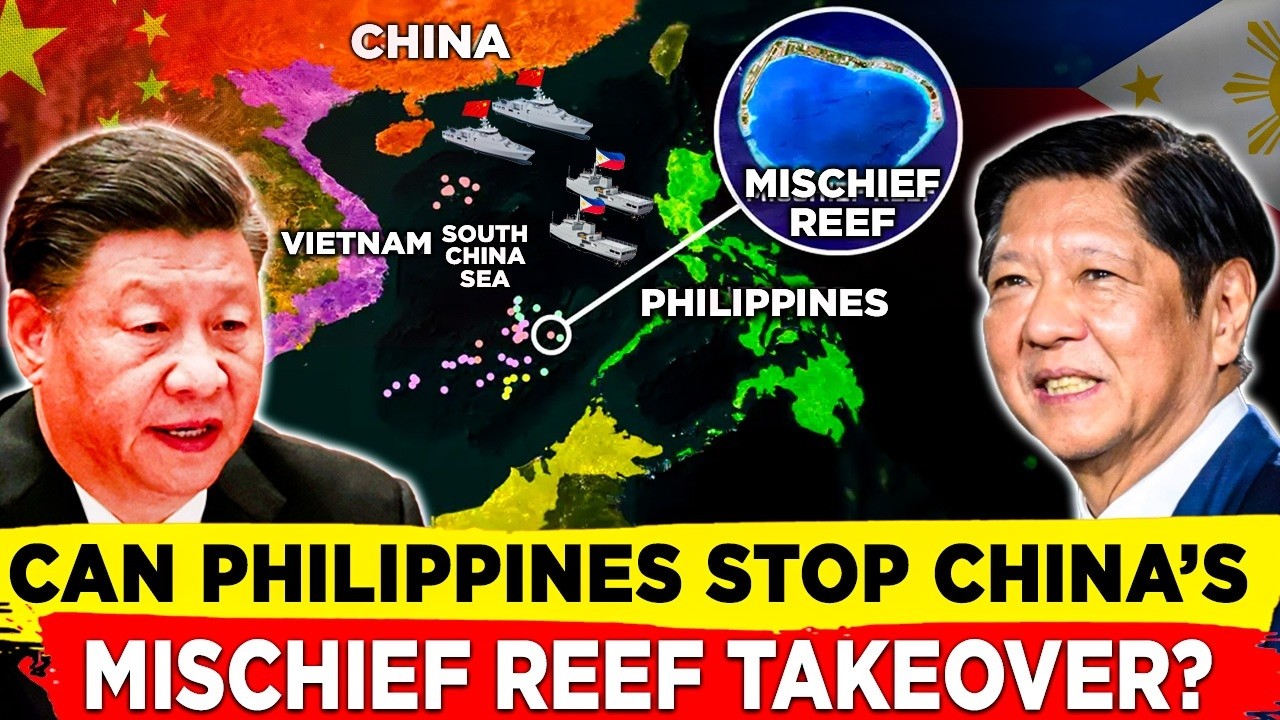
And right in the middle of this legal and geopolitical storm sits Mischief Reef, a location that has become a symbol of how territorial disputes in the South China Sea are no longer just about maps. They’re about control on the ground or more accurately, control on the water. So the real question isn’t just how China built its presence there. The deeper question is this: can the Philippines actually do anything about it now?
This analysis explores how China gradually consolidated its hold over Mischief Reef, examines the Philippines’ legal, diplomatic, and strategic responses, and ultimately asks whether Manila has any realistic pathway to challenge Beijing’s control or whether the balance of power in this part of the South China Sea has already shifted for good.https://indopacificreport.com/maintaining-a-deterrence-strategy-for-the-philippines-in-the-scarborough-shoal/
Background of Mischief Reef
If you look at a map of the South China Sea, Mischief Reef doesn’t look dramatic. It’s not a towering island or a chain of cliffs. In fact, for most of its natural history, it was barely visible at all.https://www.youtube.com/watch?v=uzL8fy-tDQ4
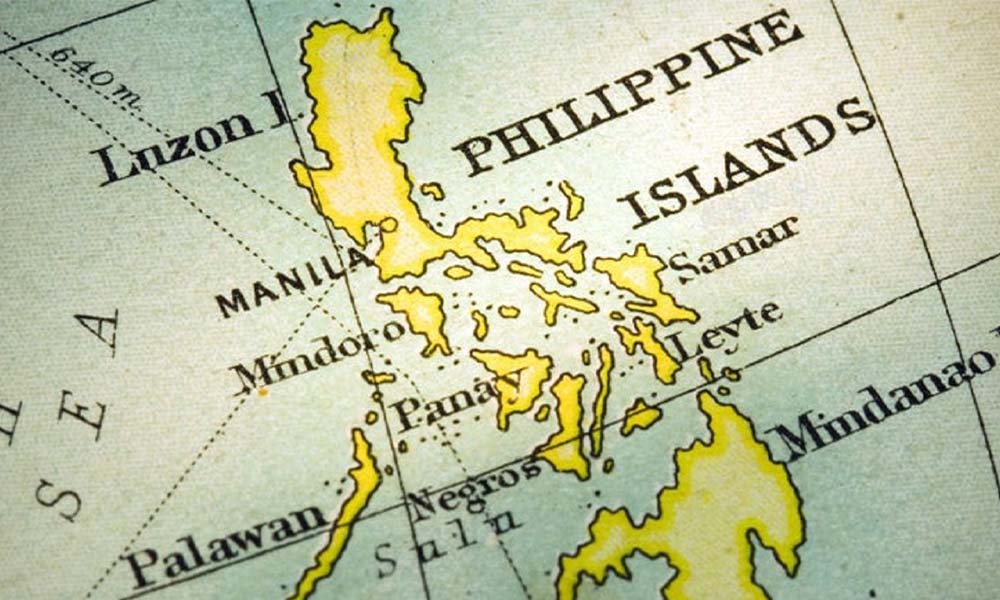
The reef sits roughly 125 nautical miles west of Palawan, the long Philippine island that stretches toward the heart of the South China Sea. That distance matters, because it places Mischief Reef well inside the maritime zone claimed by the Philippines under international law.
Here’s the technical detail that makes the dispute even more interesting. Naturally, Mischief Reef is what legal experts call a low-tide elevation. In simple terms, it’s a feature that is submerged when the tide is high and only partially visible when the tide drops. Under the rules of the United Nations Convention on the Law of the Sea, such features cannot generate their own territorial waters or exclusive economic zones.
That means the reef, on its own, doesn’t legally extend sovereignty outward. Its status depends entirely on whose maritime zone it lies within, and geographically, that zone belongs to the Philippines. But the legal definition tells only part of the story. What matters just as much is what sits around the reef.
For generations, fishermen from coastal communities in Palawan have sailed into these waters. The sea around Mischief Reef is rich with marine life, tuna, mackerel, reef fish, the kind of catch that sustains local markets and dinner tables across the Philippines. In many coastal villages, seafood isn’t just a livelihood; it’s a daily staple. Control over fishing grounds like these directly affects food security for thousands of families. Then there’s the energy factor.
The broader waters of what the Philippines calls the West Philippine Sea are believed to hold enormous energy potential, billions of barrels of oil and trillions of cubic feet of natural gas beneath the seabed. For a country that still relies heavily on imported fuel, access to these resources represents more than economic opportunity. It’s about long-term energy independence. But perhaps the biggest strategic factor is geography.https://www.youtube.com/watch?v=aov-TwOG-04
The South China Sea functions like a maritime highway connecting Northeast Asia to global markets. Tankers carrying Middle Eastern oil to Japan and South Korea pass through these waters. Container ships carrying electronics, machinery, and consumer goods travel the same routes. Whoever maintains a forward position in this area can monitor ship traffic, expand surveillance coverage, and potentially project military power far beyond the reef itself. In other words, Mischief Reef may look like a tiny speck on a map but strategically, it sits in one of the busiest crossroads of the global economy.
EDCA Is Not a U.S. Base: Manila’s Strategic Recalibration Amid Middle East Tensions
Territorial Claims
Of course, geography alone doesn’t determine ownership. The real conflict emerges from overlapping territorial claims. China argues that much of the South China Sea falls within its historical maritime boundary known as the Nine-Dash Line. This sweeping claim stretches across vast portions of the sea and overlaps with the maritime zones of several Southeast Asian states.https://www.youtube.com/watch?v=ZT-lvN0GCeU
But under modern international law, that claim has faced serious challenges. In 2016, the Permanent Court of Arbitration issued a landmark ruling in a case brought by the Philippines. The tribunal concluded that China’s claim of historic rights within the nine-dash line had no legal basis under the United Nations Convention on the Law of the Sea. It also confirmed that Mischief Reef lies within the Philippines’ exclusive economic zone.
Legally speaking, the decision was a major victory for Manila. In practical terms, however, the situation on the water did not change much. China rejected the ruling outright and continued to maintain its presence across several features in the Spratly Islands, including Mischief Reef. Meanwhile, other regional actors such as Vietnam, Malaysia, and Taiwan, also maintain claims over parts of the Spratly chain.
Philippines–US–Japan Military Drills Over the Bashi Channel (Feb 2026)
Still, the standoff between China and the Philippines remains the most intense around Mischief Reef. And that raises the question that sits at the center of this whole story: How did a reef that technically lies within the Philippines’ maritime zone end up under China’s effective control? To answer that, you have to go back to the 1990s, when the first structures quietly appeared above the water.
How China Took Over Mischief Reef
The story of how Mischief Reef slipped from a quiet patch of sea into one of the most strategically significant outposts in the South China Sea didn’t happen in a dramatic overnight takeover. It unfolded slowly, almost quietly, step by step, the kind of gradual change that’s easy to overlook until the transformation is already complete.https://www.youtube.com/watch?v=ZT-lvN0GCeU
China’s first physical presence on the reef dates back to 1995, when it built what were initially described as simple fishing shelters. At the time, the structures looked modest, even temporary. Beijing framed them as facilities meant to help fishermen operate safely in distant waters. But Manila immediately saw the move as a warning sign. The reef sat well within the maritime zone claimed by the Philippines, and the sudden appearance of Chinese structures raised alarms about a possible long-term strategy.
For years afterward, the situation remained tense but relatively limited. Patrol boats from both sides occasionally appeared in the surrounding waters. Diplomatic protests came and went. Yet the reef itself remained mostly a coral formation submerged during high tide, its political significance larger than its physical footprint. Then everything changed in the early 2010s.https://www.youtube.com/watch?v=eUW_Md1gdCg
Between 2013 and 2016, China launched one of the most ambitious land-reclamation efforts ever attempted in disputed waters. Dredging ships arrived and began pumping massive amounts of sand and sediment onto the reef. Slowly, the submerged coral formation started to grow into something entirely different. What had once been an underwater atoll was reshaped into a sprawling artificial island covering more than 1,379 acres.
Satellite images from those years show the transformation almost like a time-lapse film. First came the dredgers and construction barges. Then came the seawalls, runways, and concrete structures. Before long, Mischief Reef looked less like a reef and more like a fully engineered base rising out of the sea. But the physical construction was only part of the strategy.
Alongside the expansion, Beijing continued to reinforce its claim through diplomatic messaging and official maps referencing the Nine-Dash Line. Chinese officials repeatedly described their activities as legitimate development within what they considered historical maritime rights. At the same time, China engaged in bilateral discussions with regional states, including the Philippines. Critics argued that these negotiations often created the appearance of dialogue without changing the reality of China’s growing presence on the water.
The legal challenge came in 2016, when the Permanent Court of Arbitration issued its landmark ruling in a case brought by the Philippines. The tribunal concluded that China’s expansive claims had no legal basis under the United Nations Convention on the Law of the Sea and confirmed that Mischief Reef lies within the Philippines’ exclusive economic zone. On paper, it looked like a decisive legal victory for Manila.
But in practice, the ruling did not alter the situation on the ground. Beijing rejected the decision outright, calling it “null and void,” and continued building and maintaining its installations across the Spratly Islands.https://www.youtube.com/watch?v=eUW_Md1gdCg
Meanwhile, the artificial island at Mischief Reef evolved into something far more sophisticated than a reclaimed sandbar. Long runways capable of supporting military aircraft appeared, along with hangars, radar facilities, and harbor structures designed to accommodate naval vessels. Analysts believe the installations can support advanced surveillance systems and surface-to-air missile platforms, extending China’s ability to monitor and potentially control large portions of the surrounding sea.
This transformation effectively turned the reef into a forward military outpost, one capable of supporting what strategists call area-denial operations, where surveillance, aircraft, and missile systems combine to discourage or limit the movement of other forces. Yet perhaps the most subtle element of China’s approach lies in what security analysts describe as gray-zone tactics.
Latest Update: Philippines to Develop its Biggest Airport In the Spratly Islands Claimed by China’
Rather than relying solely on conventional naval deployments, Chinese coast guard ships and maritime militia vessels frequently patrol contested waters. These ships often shadow Philippine fishing boats, block resupply missions, or use aggressive maneuvers such as ramming or water-cannon blasts. The actions are confrontational but carefully calibrated to stay below the threshold of open military conflict.
It’s a strategy that slowly reshapes control without triggering the kind of direct confrontation that might force a larger international response. That response, when it has come, has been limited. The United States and several allied navies regularly conduct operations meant to challenge what they view as excessive maritime claims. These missions, often referred to as freedom of navigation operations, involve naval vessels sailing through contested waters to demonstrate that international sea lanes remain open. But these patrols are temporary by nature. Ships pass through and continue on their way.https://www.youtube.com/watch?v=MqawLKWnvm4
Mischief Reef, by contrast, remains fixed in place, a permanent structure sitting in the middle of disputed waters. And that permanence is what makes the situation so difficult to reverse. What began as a cluster of modest shelters in the 1990s has gradually evolved into a fortified artificial island, backed by one of the world’s most powerful militaries. Which brings us to the uncomfortable question facing policymakers in Manila today: Now that China has entrenched itself there, is it even possible for the Philippines to push back?
Impact on the Philippines
For the Philippines, the story of Mischief Reef isn’t just a distant geopolitical dispute. It has real consequences that ripple through the country’s economy, security planning, and political debates at home. The first impact shows up in the fishing communities along the coast of Palawan and other nearby provinces. For generations, Filipino fishermen sailed freely across the waters that surround the reef. These areas are among the richest fishing grounds in the South China Sea, providing tuna, reef fish, and other catches that sustain local livelihoods. But as Chinese patrols and fleets expanded their presence in the area, access became more restricted and unpredictable. Some fishermen report being chased away, while others avoid the waters altogether out of fear of confrontation.
The economic effects add up quickly. Fisheries contribute roughly 1.3 percent of the Philippines’ GDP and support the livelihoods of more than 1.6 million Filipinos. When fishing grounds become contested or inaccessible, it doesn’t just affect individual boats, it hits coastal economies, local markets, and food security across entire communities.https://www.youtube.com/watch?v=MqawLKWnvm4
Security concerns run even deeper. The military infrastructure now established on Mischief Reef strengthens China’s broader anti-access and area-denial capabilities, often shortened to A2/AD in strategic discussions. In practical terms, this means China can extend surveillance coverage, deploy aircraft, and potentially operate missile systems capable of influencing activity across large parts of the surrounding sea. For the Philippines, that complicates efforts to patrol its own maritime claims or respond quickly to incidents in disputed waters.
The situation also carries political weight inside the Philippines. Each encounter at sea, whether involving fishermen, coast guard vessels, or resupply missions, quickly becomes national news. Critics often accuse the government of reacting too cautiously, arguing that Manila should defend its maritime rights more assertively. Others argue that confrontation with a far more powerful neighbor could create greater risks. As a result, every administration faces the same difficult balancing act: defending sovereignty while avoiding a crisis that could spiral out of control.
Can Philippines, Taiwan, Japan and South Korea Join Forces Against China?
Diplomatically, the challenge becomes even more delicate. China remains one of the Philippines’ largest trading partners and an important economic player in the region. At the same time, Manila has deepened defense cooperation with partners such as the United States, Japan, and Australia in response to rising tensions in the South China Sea. Navigating these relationships requires careful diplomacy. Too much confrontation with Beijing risks economic fallout, while too little resistance risks weakening Manila’s maritime claims. This is the strategic tightrope the Philippines now walks every day.
https://www.youtube.com/watch?v=ifw9vfWP6Mc
Can the Philippines Stop China?
When analysts ask whether the Philippines can stop China at Mischief Reef, the answer usually begins with a realistic assessment of military power. China’s naval and coast guard fleets are vastly larger than those of the Philippines. The scale difference is hard to ignore. China operates one of the world’s largest navies, backed by an extensive coast guard and maritime militia network. The Philippine Navy, by contrast, remains in the process of modernization and operates with far fewer vessels and limited resources. This imbalance makes any unilateral military attempt to remove China from Mischief Reef extremely unlikely.
Because of that gap, Philippine strategy increasingly focuses on asymmetric approaches rather than direct confrontation. Strengthening coastal surveillance systems, improving maritime domain awareness, and deploying defensive missile capabilities can help raise the cost of aggression without triggering a full-scale military conflict. Joint patrols and coordinated monitoring operations with allied forces also play a role in maintaining a presence in contested waters.
Diplomacy remains another key tool. The Philippines continues to highlight the legal significance of the 2016 ruling by the Permanent Court of Arbitration, which confirmed that China’s sweeping claims have no legal basis under the United Nations Convention on the Law of the Sea. By consistently invoking international law in diplomatic forums, Manila keeps global attention focused on the dispute and reinforces the legitimacy of its position.
Can Philippines, Taiwan, Japan and South Korea Join Forces Against China?
Regional cooperation could also matter, although it comes with its own challenges. Within the Association of Southeast Asian Nations, member states hold different views on how strongly to confront China. Some depend heavily on economic ties with Beijing, which often makes consensus difficult. Still, a stronger and more unified regional stance could gradually increase diplomatic pressure for rules-based behavior in the South China Sea.
Economic and strategic partnerships also play a growing role. The Philippines has expanded cooperation with the United States, Japan, and Australia through military exercises, technology transfers, and intelligence sharing. These partnerships strengthen maritime awareness and help the Philippines monitor developments across its surrounding waters more effectively.https://www.youtube.com/watch?v=ifw9vfWP6Mc
Even so, most analysts agree on a sobering reality: reversing China’s physical presence at Mischief Reef through military means is highly improbable. The more realistic objective is containment, limiting further expansion, reinforcing legal claims, and ensuring that no single power can dominate the entire region unchecked.
Lessons Learned and Regional Implications
The experience of Mischief Reef offers important lessons, not only for the Philippines but for the wider region. For the Philippines itself, the situation highlights the importance of preparedness and long-term strategic planning. Legal victories, such as the arbitration ruling, matter enormously in shaping international opinion. But without sustained diplomatic engagement, military readiness, and strong partnerships, legal arguments alone cannot enforce maritime rights.
For regional organizations like the Association of Southeast Asian Nations, the dispute reveals the risks of fragmentation. When member states approach maritime disputes with differing priorities, it becomes easier for stronger powers to shape the strategic environment. A more coordinated regional framework could help smaller states defend shared interests and uphold international law.
Militarization of the South China sea and its regional and global ramifications
For global powers, the situation represents a broader test of the international system. The dispute touches on fundamental questions about freedom of navigation, the authority of international legal institutions, and the balance between power and law in international relations. The way these issues are managed in the South China Sea may influence how similar disputes are handled elsewhere in the future.
Conclusion
China’s consolidation of control over Mischief Reef illustrates a difficult reality of modern geopolitics. Even when international law appears clear, as demonstrated by the 2016 arbitration ruling, strategic realities on the ground can tell a different story.
For the Philippines, reversing China’s presence at the reef alone is unlikely. But that does not mean the situation is entirely beyond influence. Through persistent diplomacy, stronger alliances, and continued engagement with international institutions, Manila can shape the broader environment in which the dispute unfolds.
In the end, the future of the South China Sea will depend not just on military strength, but on the willingness of regional states and global powers to defend the principles of maritime law and cooperative security.
Because if those principles weaken, the consequences will stretch far beyond a single reef rising out of the water. They will shape the balance of power and the stability of one of the world’s most important oceans, for decades to come.https://youtu.be/6U3f_7DmeMs?si=svMat8vn7gbFuJv8