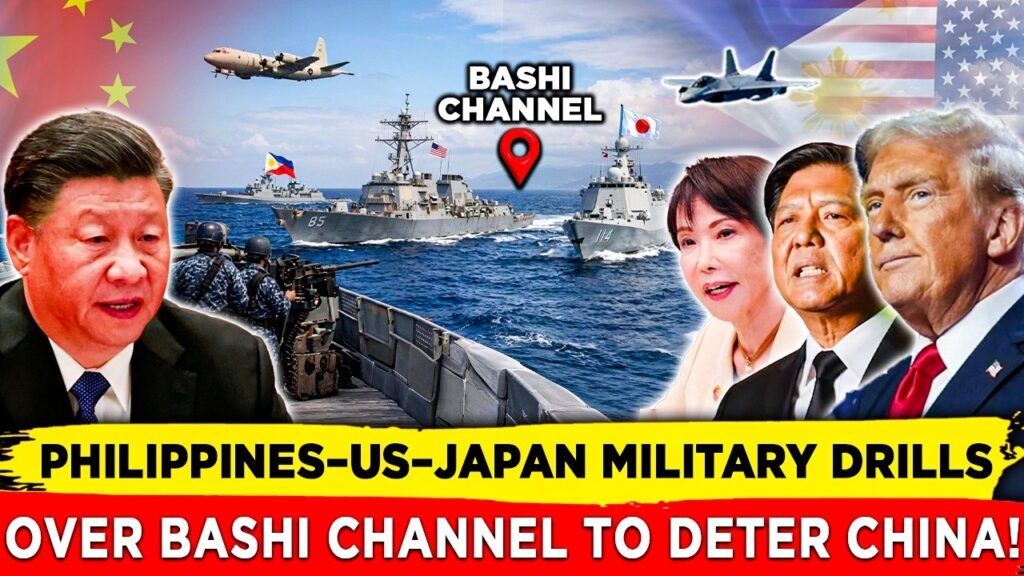
Philippines–US–Japan Military Drills Over the Bashi Channel (Feb 2026)
The morning fog over Batanes hung thick, curling around the jagged cliffs like it was hiding something. Something big. I was standing there, watching the tiny fishing boats bob against waves that now shared space with gray silhouettes of warships, Philippine, US, and Japanese, sliding through the Bashi Channel. “Control this channel, and you control the gateway to the South China Sea,” muttered an old sailor beside me, half proud, half worried. He’s seen the waters all his life, but never like this.
A fighter jet screamed overhead, chasing a training target that seemed too small against the endless blue. Every move of these vessels, every loop of aircraft, felt like the rehearsal for a game nobody wants to play but everyone knows could happen. It’s hard to describe the mix of awe and dread. You realize this isn’t just about maps or military doctrines. It’s about control, survival, and the silent power struggles that ripple through every wave.

I thought of the history layered beneath these waters, the naval maneuvers during past tensions, the quiet standoffs that never made headlines, and now, the drills that are as much a message as a practice. For the people here, life goes on: nets are mended, children run along the shore. But just beyond, in that 60-mile stretch to Taiwan, the world’s biggest powers are playing a game that could decide the first moves of a much larger conflict. And you can feel it, like the wind whipping across the cliffs, on the edge of calm and chaos.
The 2026 Joint Exercise — Multilateral Maritime Cooperative Activity (MMCA)
The 2026 Multilateral Maritime Cooperative Activity or MMCA, as the military calls it, wrapped up quietly on Thursday, 26 February, but make no mistake: “quiet” doesn’t mean insignificant. For four days, the northernmost waters of the Philippines transformed into a theater of precision, coordination, and high-stakes signaling. Philippine, US, and Japanese forces had converged here in an area few drills ever reach, the Bashi Channel, that narrow corridor linking the South China Sea to the Western Pacific.
U.S. and Japan Upgraded Military Command Amid Rising China Threat
From the cliffs of Batanes, you could see the Philippine FA-50 light fighters slicing through the sky, while US P-8 Poseidons and Japanese P-3 Orions hummed above in carefully choreographed patterns. Below, the BRP Antonio Luna, the USS Dewey, and the Philippine Coast Guard cutter BRP Gabriela Silang traced disciplined arcs across the waters, executing maneuvers that were part ballet, part message. Every aircraft, every vessel, every signal was a demonstration: these forces can operate together seamlessly, across air, sea, and tactical domains, even in one of the region’s most complex maritime theaters.
https://www.youtube.com/watch?v=Ev3P5aWe8Co
What makes this exercise particularly remarkable is its location. Past MMCA drills tended to stick closer to the South China Sea. This year, the stage shifted north, to the Bashi Channel itself, a narrow stretch barely 60 miles wide, but one of the most strategically charged waterways in Asia. By taking the drills here, the three militaries weren’t just testing interoperability; they were signaling a new geographic and strategic reach, showing that multilateral cooperation can extend beyond familiar waters, all the way to the front lines of potential tension over Taiwan.

For locals watching from shore, life went on. Fishermen mended nets, kids ran along the windswept cliffs, and the waves rolled like nothing had changed. But in the sky and on the sea, history quietly pressed forward. This wasn’t just another exercise. It was a rehearsal for the unpredictable, a glimpse of how air, sea, and strategy collide when the world’s great powers meet at the edge of calm and chaos.
China Demands Philippines Stop U.S. Japan Military Cooperation in West Philippine Sea
Political & Diplomatic Reactions
As the dust of the MMCA drills settled over the northern Philippines, the diplomatic ripples began to spread and they were loud. Across the East China Sea in Beijing, China’s Southern Theatre Command didn’t mince words. The drills, they said, were nothing less than an attempt to “co-opt non-regional states” and “disrupt peace and stability.” In a show of muscle, China sent its own ships on what it called a “routine patrol” in the South China Sea during the same period, though everyone watching knew it was a pointed reply. To Beijing, foreign powers operating so close to Taiwan isn’t training; it’s encroachment. And any coordinated military movement involving the US, Japan, and the Philippines near the Bashi Channel? That’s a provocation they take very seriously.
Manila, meanwhile, struck a careful, tense balance. President Ferdinand Marcos Jr. warned publicly that the Philippines could be “dragged kicking and screaming” into a Taiwan conflict, a phrase that sounded almost casual, yet carried a weighty undertone of the real danger at hand. It was a reminder that while the drills showcased interoperability and readiness, the stakes weren’t hypothetical. Every move in these northern waters had diplomatic consequences, and every signal was being read closely in capitals across the region.
Japan, too, has felt the heat. In recent years, Tokyo flirted with the idea of directly defending Taiwan, a stance that drew sharp sanctions and rebukes from Beijing. Now, whispers of future deployments, like surface-to-air missile systems on remote islands near Taiwan by 2031, have only added fuel to the fire. For Japan, participation in the MMCA is both reassurance to allies and a clear signal to China: the partnership isn’t just theoretical; it can project force and coordination across the critical corridors of the Western Pacific.https://www.youtube.com/watch?v=iJ7w7zu3v4A
In short, what unfolded north of Luzon wasn’t just a military exercise, it was a live demonstration of strategy, signaling, and the delicate diplomacy that threads the razor’s edge between deterrence and confrontation. And as always, the question lingers: how far will each player push before someone misreads the intent?
Operational & Military Details
Over the four days of MMCA, the skies and waters north of Luzon came alive with movement, noise, and precision. Philippine FA-50 fighters, US P-8 Poseidons, and Japanese P-3 Orions crisscrossed the northern Philippine airspace in carefully timed patrols. Observers noted how the flights weren’t just about presence, they were exercises in integrated surveillance, testing how three militaries could coordinate in a contested environment where every second counts.
US Commits $144M to Strengthen Military Facilities in the Philippines
Below, the seas were just as busy. The Philippine guided missile frigate BRP Antonio Luna fired its guns in live-fire drills, the sharp echoes bouncing across the waves. The US destroyer USS Dewey and the Philippine Coast Guard cutter BRP Gabriela Silang carved tactical patterns through the waters, practicing maneuvers that looked like a choreographed dance but were, in fact, rehearsal for real-world threats. For everyone watching, it was easy to forget that these were drills—each turn of a ship, each formation of aircraft, carried lessons that could decide life or death in a crisis.
The tactical aims were straightforward but critical: improve interoperability between air and naval units, validate communication channels and command structures, and practice coordinated defense in strategically sensitive maritime zones. Yet beyond the immediate exercises, the drills also signal a bigger pattern. They are part of an expanding series of Philippines-US-Japan interoperability activities, tied to formal agreements like the Philippines–Japan Reciprocal Access Agreement ratified in late 2024. In other words, this isn’t an isolated event. It’s a piece of a growing puzzle, showing how these allies are thinking long-term, preparing for scenarios that most of the world prefers not to imagine.https://youtu.be/F5krgC4CYR0?si=j8WIu5habaOSuoeg
Strategic Implications
The Bashi Channel is more than just a narrow stretch of water, it’s a strategic fulcrum where the balance of power in Northeast Asia can shift in an instant. By sending ships and aircraft into these northern waters, the Philippines, US, and Japan are quietly rebalancing maritime power. The drills strengthen the ability of non-Chinese forces to respond at key chokepoints and sharpen their capacity to monitor, and if needed, counter hostile actions in a space that could become a flashpoint overnight.
Every coordinated maneuver also sends a message to Beijing: these are not isolated exercises. They show a united front among like-minded maritime powers, reinforcing deterrence without tipping into outright confrontation. The choreography of aircraft over Batanes and the disciplined arcs of warships west of Luzon aren’t just training, they’re a signal: the channel isn’t anyone’s private lane anymore.https://indopacificreport.com/japan-plans-to-export-military-command/
And when it comes to Taiwan, the stakes are even higher. Control or at least influence, over the Bashi Channel could prove decisive in any contingency. By practicing rapid, integrated air and sea deployments, these allied forces are preparing for scenarios where speed and coordination might be the difference between strategic advantage and disaster. In other words, these drills aren’t just about readiness; they’re about shaping the possible outcomes of a crisis before it even begins.
Japan’s Growing Military Ties with the Philippines: What It Means for China and the Region?
Figures & Metrics
To really grasp the scale and significance of the 2026 MMCA, the numbers tell a story of their own. The Bashi Channel, a mere 100 kilometers (about 60 miles) from the northern Philippines to Taiwan, became the stage for four intense days of drills, stretching from 23 to 26 February.
Three nations, Philippines, US, and Japan, brought together aircraft, warships, and coast guard units, all operating over Batanes airspace and the waters west of Luzon. For the first time, these exercises reached this far north, beyond the usual South China Sea corridors, marking a historic expansion in geographic and strategic scope. Every figure, every distance, every day of coordinated action underscores just how carefully these drills were planned, and how much weight they carry in shaping regional security.
Conclusion
The 2026 MMCA over the Bashi Channel isn’t just another exercise on a map, it’s a turning point. For the first time, allied forces have pushed well beyond the familiar South China Sea waters, stepping into areas that lie immediately next to Taiwan, where the stakes are highest and the tension, palpable.
On the operational side, the drills sharpened readiness and interoperability, proving that these forces can move, communicate, and coordinate seamlessly under pressure. Politically, they sent a clear message: the Philippines, US, and Japan are willing to project presence in sensitive waters, even as China watches closely and labels such moves destabilizing. Strategically, this isn’t a one-off. The drills reinforce a pattern of trilateral integration, hinting at a future where cooperation continues to grow in both scope and geographic reach, shaping the balance of power in Northeast Asia for years to come.https://youtu.be/F5krgC4CYR0?si=j8WIu5habaOSuoeg