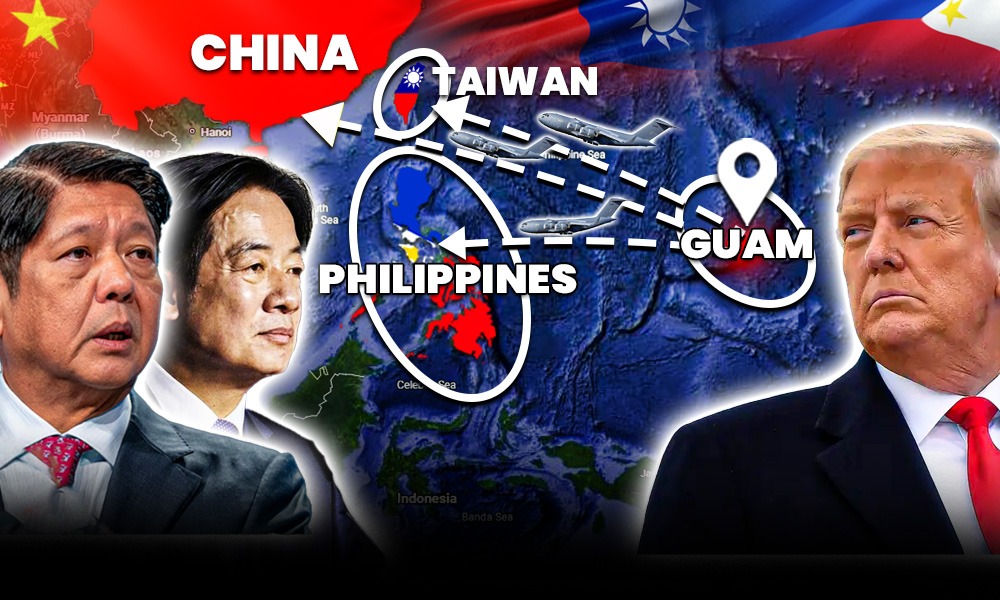
Guam, the United States’ westernmost territory, is fast becoming one of the most important pieces on the Indo-Pacific chessboard. Its position, about 1,600 miles east of Manila and 1,700 miles south of Tokyo, places it close enough to key Asian flashpoints for rapid action, yet far enough to provide a defensive cushion from the immediate reach of China’s growing missile arsenal. The island’s unique status as U.S. sovereign soil gives American forces a rare degree of freedom. Unlike bases in Japan or South Korea, Guam requires no host-nation approval for deployments, allowing Washington to surge bombers, submarines, and logistics assets without diplomatic delay. This autonomy makes Guam a cornerstone of U.S. forward presence and a dependable pivot in any Indo-Pacific contingency.
Its geography is strategically decisive. Roughly 4,000 miles west of Hawaii, half the distance to Beijing compared to Honolulu, Guam offers unmatched response time for U.S. and allied operations. In crises over Taiwan or the South China Sea, it serves as the bridge between continental U.S. forces and first-line allies like the Philippines and Japan. As the centerpiece of the Second Island Chain, a defensive arc running from the Ogasawara Islands through the Marianas to Palau, Guam provides the deeper layer of a U.S. defense-in-depth strategy. Should front-line bases in Japan, Okinawa, or the northern Philippines come under attack, Guam’s hardened facilities and distance create a more survivable fallback for sustained operations.
Guam’s military infrastructure is formidable. Andersen Air Force Base hosts the largest munitions stockpile in the Air Force and regularly deploys B-1B and B-2 strategic bombers capable of long-range precision strikes. Naval Base Guam is home to Submarine Squadron 15 and forward-deployed submarine tenders, ensuring continuous undersea patrols. Together these assets enable sustained sea-air operations and rapid escalation control across the Western Pacific. The island also anchors U.S. efforts to counter China’s rapid rise. Beijing now fields over 370 warships and submarines, the world’s largest fleet and is testing advanced platforms like the aircraft carrier Fujian and extra-large uncrewed underwater vehicles. Chinese coast guard and militia ships have normalized dangerous maneuvers around Taiwan and in Philippine waters. Guam fits squarely into Washington’s island-chain strategy, designed to contain such expansion and deny China unchallenged access to the Pacific.
For the Philippines and Taiwan, Guam provides vital strategic depth. Its location makes it the closest major, resilient U.S. logistics hub for reinforcing front-line bases, enabling rapid troop movements and sustained operations even if Philippine or Taiwanese facilities are struck. U.S. wargames consistently show that Guam’s ability to stay operational under fire could determine whether timely reinforcements reach these allies.
This mission is reinforced by U.S. security commitments. The 1951 Mutual Defense Treaty with the Philippines, updated in 2023 to cover attacks on coast guard vessels anywhere in the South China Sea, ensures American military support. While the Taiwan Relations Act stops short of a formal treaty, it obliges Washington to provide Taiwan with the means to defend itself, a policy backed by increasingly open joint training and intelligence sharing. History underscores Guam’s enduring value. During World War II, it served as a critical launch pad for the liberation of the Philippines and assaults on Japan. After the Vietnam War it became a humanitarian hub for refugees. More recently, combined exercises involving U.S., Japanese, Australian, and Philippine warships have shown how Guam supports multilateral security and disaster-relief operations alike.
Looking ahead, massive investment, over $10 billion, with Japan funding about 60%, is hardening Guam’s resilience. Projects such as the One Guam Comprehensive Infrastructure Resiliency Plan are burying power lines and reinforcing substations. The U.S. is also deploying a new Guam Defense System with THAAD and Patriot missile batteries, including advanced radars capable of intercepting hypersonic threats, to ensure operations can continue even under missile attack. These elements explain why Guam is now viewed as an indispensable, sovereign U.S. platform whose security is directly tied to the survival of Taiwan and the sovereignty of the Philippines. By providing unmatched logistical reach, survivability, and deterrent power, Guam has become the linked frontline that will shape the balance of power and the rules of order across the Indo-Pacific for decades to come.
Geopolitical Significance of Guam as a U.S. Stronghold in the Pacific Ocean
Guam’s unique political status makes it the most reliable forward foothold the United States has in the Western Pacific. Because Guam is a U.S. territory, not a foreign host nation, the Pentagon doesn’t need basing treaties, annual renewals, or parliamentary votes to surge forces, stockpile munitions, run 24/7 ISR, or launch combat sorties. That translates into faster decision-cycles, fewer political veto points, and assured access in a crisis, advantages no overseas base can fully match. It also simplifies command-and-control and logistics: U.S. law, procurement, and security rules apply end-to-end, which is critical when moving sensitive weapons, cyber and space assets, or nuclear-powered submarines. For allies like the Philippines and Taiwan, that permanence matters: Guam is the anchor that keeps U.S. reinforcement plans credible even when regional politics get noisy.
Geography turns that legal certainty into real operational speed. Sitting roughly 4,000 miles west of Hawaii and far closer to Asian flashpoints, Guam is about twice as close to Beijing as Honolulu and only hours by air from Luzon and the Taiwan Strait. From Andersen Air Force Base, tankers, airlifters, and long-range bombers can flow quickly into the first island chain, while Navy and Marine forces stage in the Philippine Sea without telegraphing routes from the continental United States. Ships can reload, repair, and re-crew at Guam and turn back to sea in days rather than weeks, shrinking the time-distance problem that complicates deterrence. Just as important, forces staged on Guam are outside the tightest rings of coastal anti-ship and anti-air threats, yet close enough to surge forward or strike when needed, precisely the “strategic depth” Manila and Taipei require to complicate any rapid fait accompli.
The island’s military infrastructure turns that depth into sustained combat power. Andersen AFB houses vast fuel farms and one of the Air Force’s largest munitions stockpiles, enabling rotations of B-2, B-1B, and B-52 bombers, plus Agile Combat Employment packages that can disperse across the theater on short notice. Next door, Naval Base Guam hosts Submarine Squadron 15 with nuclear-powered fast-attack submarines and two forward-deployed submarine tenders, giving U.S. boats a rare ability to rearm, repair, and redeploy without returning to the West Coast. Add in a permanently based THAAD battery and the build-out of an integrated Guam air- and missile-defense architecture, and the island becomes a hardened logistics hub, strike platform, and sanctuary all at once. For the Philippines and Taiwan, that combination means reliable resupply, rapid reinforcement, and continuous undersea and air pressure on any adversary, exactly the kind of strategic depth that strengthens deterrence and buys time when it matters most.
Why Guam Is Important: The Rise of China and the U.S. Island Chain Strategy?
China’s rapid ascent as both an economic and military power sets the backdrop for Guam’s growing strategic relevance. By hull count, China now possesses the world’s largest navy, over 370 ships and submarines and continues to launch advanced vessels at a striking pace. Its newest aircraft carrier, the Fujian, signals the ability to field stealth-capable carrier aviation and extend power projection across the Western Pacific. Meanwhile, Beijing is steadily eroding Taiwan’s sovereignty, using its coast guard and maritime militia to normalize military operations around outlying islands like Kinmen and Pratas. These gray-zone incursions test Taiwan’s responses and wear down its defenses without sparking open conflict. For U.S. planners, these trends mean China can mass force or choke sea lanes with little warning, threatening freedom of navigation and the credibility of American security guarantees.
The United States answers this challenge with a three-tiered “Island Chain Strategy,” a network of defensive lines stretching from Japan through Taiwan and the Philippines to the Malay Peninsula. Guam, an American territory, sits just behind the First Island Chain and provides a secure, sovereign platform from which to project power forward. Pentagon officials describe the build-up across these island arcs as a way to “increase deterrence and power projection for possible responses to crises and disasters” in support of allies like Japan, South Korea, the Philippines, and Taiwan. By anchoring the second line of this chain, Guam serves as both a shield and a springboard, close enough to reinforce partners rapidly, yet far enough to remain a hardened, sustainable base even under missile threat. These dynamics explain why Guam has become indispensable. China’s massive naval growth and persistent pressure on Taiwan create the very scenarios the Island Chain Strategy is designed to counter. And because Guam is U.S. soil, it offers an unfettered launch point for air, sea, and cyber operations, strategic depth that helps ensure a free and open Indo-Pacific even as the military balance in Asia grows more volatile.
Philippines Calls on the World to Stop China’s South China Sea Grab
Guam as a Stronghold of the U.S. Second Island Chain Strategy
Guam anchors the Second Island Chain, a key layer of the U.S. forward defense concept that complements the First Island Chain of Japan, Taiwan, and the Philippines. The Second Island Chain stretches from Japan’s remote Ogasawara Islands through the Mariana Islands, including Guam and onward to Palau. Unlike the First Island Chain, which lies within immediate reach of China’s coastal missile and air forces, this second arc provides defense in depth, giving the United States a more survivable base network if the front line is threatened or temporarily denied.
Guam’s location, roughly 1,800 miles from China’s coastline, is central to this defensive logic. While this distance does not place it beyond the reach of China’s rapidly growing arsenal of intermediate-range ballistic missiles (IRBMs), including the Dongfeng (DF) series, it significantly reduces vulnerability compared to bases in Okinawa or Luzon. The extra distance complicates Chinese targeting and buys the U.S. and its allies critical time to detect launches, maneuver assets, and mount countermeasures, thereby weakening Beijing’s Anti-Access/Area Denial (A2/AD) strategy that aims to keep U.S. forces out of the Western Pacific in a crisis.
To harden Guam against these very threats, the U.S. has embarked on an ambitious, multi-layered Guam Defense System (GDS). By March 2025, the island hosted six Terminal High Altitude Area Defense (THAAD) missile launchers and a powerful fire-control radar, with plans to expand into a full-spectrum, 360-degree defensive shield. The Pentagon has already approved the addition of a new Patriot air-defense battalion, and testing of the Lower Tier Air and Missile Defense Sensor (LTAMDS) radar recently demonstrated the ability to intercept a fast, air-breathing target with a Patriot missile, exactly the sort of hypersonic-like threat expected in a high-end conflict. These systems integrate with sea-based Aegis ships and U.S. Space Force early-warning networks, creating overlapping layers of detection and interception.
This transformation makes Guam more than a logistics hub; it is now a heavily fortified bastion capable of sustaining operations even under missile assault. By anchoring the Second Island Chain with robust missile defenses and long-range strike forces, Guam gives Washington a resilient springboard for reinforcing allies like the Philippines and Taiwan and for projecting power deep into the Western Pacific. In a scenario where the First Island Chain is compromised, Guam ensures that the United States retains both the reach and the staying power to keep the Indo-Pacific open and free.
USS Ohio Submarine Deployment in Philippines Leaves China Furious
Significance of Guam for the Philippines and Taiwan
Guam’s strategic value to the Philippines and Taiwan begins with geography. Although not immediate neighbors, the island sits within rapid-reinforcement distance of the two flashpoints that matter most in the western Pacific: the Luzon Strait, less than 100 miles wide at its narrowest, and the Taiwan Strait beyond it. This makes Guam the nearest large, secure U.S. base complex able to sustain prolonged operations in a crisis. As one Indo-Pacific Command assessment puts it, “Taiwan’s defense is deeply tied to Guam’s resilience. Our bases serve as forward logistics hubs, power projection points, and strategic assets that support Taiwan’s deterrence.” In practical terms, Guam acts as the rear area for both Manila and Taipei, where reinforcements, munitions, and supplies can be pre-positioned and launched quickly if conflict erupts.
The island’s military infrastructure turns this geography into hard power. Andersen Air Force Base, with one of the largest munitions stockpiles in the entire U.S. Air Force, can host B-1B and B-2 strategic bombers for long-range strike, while Naval Base Guam, home to nuclear-powered fast-attack submarines and submarine tenders, supports rapid undersea and surface operations across the Philippine Sea and Taiwan Strait. U.S. wargames consistently show that in most Taiwan- or Luzon-based scenarios, timely support hinges on Guam’s ability to remain operational under sustained missile or cyberattack. For this reason Washington is hardening runways, expanding fuel depots, and reinforcing command centers to keep Guam mission-ready under fire.
For both the Philippines and Taiwan, Guam ultimately provides strategic depth and deterrence by resiliency. The U.S. strategy aims to ensure that even if Guam were struck, it could absorb damage and continue to generate combat power, denying Beijing the hope of a quick, decisive blow. This resilience strengthens deterrence by guaranteeing that supply lines and U.S. combat presence would endure. As one regional strategist warns, “If Taiwan falls, the geopolitical map shifts overnight, and Guam’s vulnerability skyrockets. The buffer that Taiwan provides is not just geographic; it is a shield for Guam and the entire Pacific.” Conversely, Guam’s own staying power serves as a shield for Taiwan and the Philippines, assuring that any attack on them would still draw a sustained and credible U.S. response.
In sum, Guam is far more than a distant outpost. By combining secure geography, massive logistics and firepower, and a hardened defensive shell, the island gives Washington and by extension Manila and Taipei, the depth and staying power needed to counter China’s expanding naval and missile power and to keep vital Pacific sea lanes free.
U.S. Mutual Defense Treaty (MDT) with the Philippines and Obligations to Defend Both Nations
The 1951 U.S.–Philippines Mutual Defense Treaty (MDT) remains the foundation of America’s security commitment to Manila. It obliges both nations to aid each other if either is attacked in the Pacific. This pledge was sharpened in 2023, when the two allies issued Bilateral Defense Guidelines explicitly confirming that an armed attack “anywhere in the South China Sea” including on public vessels, coast guard ships, aircraft, or armed forces, would automatically trigger the MDT’s mutual defense obligations. The clarification directly responds to Chinese harassment around flashpoints such as Second Thomas Shoal, where Philippine supply missions have repeatedly faced Chinese ramming and water-cannon attacks. To give these guarantees practical force, Manila has expanded U.S. military access under the Enhanced Defense Cooperation Agreement (EDCA), adding four new bases, several near the Luzon Strait. These facilities link seamlessly with Guam’s logistics and strike capabilities, ensuring U.S. forces can surge quickly to defend Philippine territory and sea lanes.
The American security posture toward Taiwan is different but complementary. Under the Taiwan Relations Act (1979), the United States does not pledge mutual defense but is legally committed to provide Taipei with the means to defend itself and to maintain the capacity to resist force or coercion. China’s foreign ministry consistently warns that Taiwan is “the core of China’s core interest,” yet U.S.–Taiwan security ties continue to quietly deepen. Notably, Taiwanese military observers recently joined a U.S.–Philippines–Japan exercises in the Batanes Islands, only about 100 miles from Taiwan, underscoring growing operational connections. These arrangements, a formal treaty with the Philippines and a robust if unofficial commitment to Taiwan, create a layered regional defense network. They tie Guam’s formidable bases and supply hubs to frontline allies and partners, signaling that any attack on Philippine forces or a violent move against Taiwan would risk immediate and sustained U.S. military involvement.
Panatag Shoal Sparks Controversy as China Releases New Maritime Baselines
Case Studies and Relevant Examples
Guam’s strategic role is best understood through the lens of history, modern security cooperation, and hard-earned lessons in resilience. First, its wartime record is unmistakable. During World War II, Guam evolved into a critical U.S. logistics and staging hub for the final campaigns against Imperial Japan. Its deep-water harbors, long runways, and central Pacific location allowed American forces to stockpile munitions, fuel, and provisions, while also providing a launch point for sustained air raids and naval offensives. This experience demonstrated how the island can anchor massive logistics and combat operations in any major Indo-Pacific conflict.
Second, Guam’s importance goes well beyond combat operations. In the aftermath of the Vietnam War, the island played an essential humanitarian role by processing and supporting tens of thousands of Vietnamese refugees. This episode proved Guam’s capacity to serve as a large-scale evacuation and disaster-relief hub, a function that remains crucial in an era of increasingly frequent natural disasters and potential regional crises.
Third, Guam underpins today’s multilateral security architecture. In 2024, it supported a combined exercise involving U.S., Japanese, Australian, and Philippine warships near the Philippines, showcasing the island’s ability to host and supply allied naval and air forces. Its ports, airfields, and munitions stockpiles enabled a high-tempo joint operation designed to sharpen coordination and signal allied resolve against coercive actions in the South China Sea and around Taiwan.
Finally, Guam’s strategic value comes with vulnerabilities. When Typhoon Mawar struck in 2023, it left 98 percent of the island, including critical U.S. military bases, without power. Restoring electricity took nearly two months and cost the local utility $33 million, highlighting how a single severe weather event can disrupt military readiness. This has spurred urgent U.S. efforts to harden Guam’s power grid, diversify energy sources, and fortify key facilities against both natural disasters and potential missile or cyberattacks. These historical, humanitarian, operational, and infrastructure lessons reveal Guam as far more than a distant outpost. It is a proven wartime logistics hub, humanitarian refuge, and allied training ground, but also a resilience challenge that Washington must address to ensure the island remains a reliable anchor for U.S. strategy and a secure support base for partners like the Philippines and Taiwan.
Philippines Rocked by ₱545B Corruption Scandal as West Philippine Sea Crisis Grows
What the Future Holds for Guam?
Guam is set to become an even more formidable linchpin of U.S. power projection and allied security in the Indo-Pacific. First, massive new investments will transform the island into a next-generation fortress. The U.S. military has mapped out a $10.3 billion build-up, with **Japan covering about $6.1 billion, roughly 60 percent of the total, **in a rare example of cost-sharing that highlights shared stakes in deterring conflict. This long-term funding supports the relocation of thousands of U.S. Marines from Okinawa, the expansion of air and naval facilities, and the deployment of cutting-edge missile defenses. Together, these projects signal an enduring, multinational commitment to keep Guam ready for rapid combat operations and sustained deterrence.
Second, resilience is moving to the forefront of planning. Hard lessons from Typhoon Mawar in 2023, which left nearly the entire island without power for weeks, have spurred the One Guam Comprehensive Infrastructure Resiliency Plan. This initiative focuses on burying power transmission lines, reinforcing substations, and upgrading water and communications networks, ensuring that Guam’s civilian population and military installations can keep functioning even under extreme weather, cyberattacks, or missile strikes. By making Guam harder to disable, Washington and its partners aim to guarantee uninterrupted logistics and command in any crisis.
Third, Guam’s role as an allied hub will deepen. U.S. planners envision expanded intelligence sharing, cybersecurity collaboration, and joint disaster-preparedness drills with key partners such as the Philippines and Taiwan. Regular combined naval and air exercises, along with enhanced communications links, will knit Guam more tightly into a regional security web that can respond swiftly to anything from natural disasters to armed aggression. The island will increasingly serve as the nerve center of a cooperative defense network stretching across the Western Pacific.
1 Philippine Navy Vessel Against 22 Chinese Ships at Scarborough Shoal
End Words
In sum, Guam is evolving from a forward base into an indispensable, sovereign U.S. stronghold that underwrites the security of the wider Indo-Pacific. Its reinforced infrastructure, multinational funding, and integrated alliances will give Washington and its partners a resilient platform from which to deter or defeat coercion. The stakes go beyond the island itself: Guam’s security is directly tied to the survival of Taiwan and the sovereignty of the Philippines, linked frontlines in a single strategic contest. Whether in peacetime deterrence or wartime support, Guam’s future will shape the balance of power and the defense of international norms across the Pacific.