Fresh satellite images have just blown the lid on what Beijing doesn’t want the world to see. Captured by Maxar Technologies, the photos show a battered Chinese Coast Guard ship docked at the Yulin Naval Base in Hainan, flanked by tugboats as crews scramble to repair its mangled frame. The most striking detail? A bow that looks crushed inward, the steel warped and twisted, the kind of wound no routine patrol could explain.
The ship sits in silence at one of China’s most important naval facilities, tucked near Sanya, the gateway to the South China Sea. Its sudden appearance in dry dock tells a story Beijing hasn’t spoken a word about. There’s been no official admission, no statement, no mention in Chinese media. Just silence. But the imagery doesn’t lie, this was not an accident in port.
The damage traces back to August 2025, when the Chinese Coast Guard and the People’s Liberation Army Navy were running an aggressive blockade near Scarborough Shoal. In the chaos of a high-speed pursuit of the Philippine Coast Guard’s BRP Suluan, two Chinese vessels, one a navy destroyer, the other this coast guard cutter, collided with each other. The clash left the cutter crippled and the destroyer limping away, a humiliation caught on video by the very ship they were trying to corner.
And now, weeks later, the satellite record confirms what Beijing won’t say out loud: the Chinese Coast Guard, the pride of its gray-zone campaign, is repairing one of its own ships after a self-inflicted wound. In the high-stakes contest of the South China Sea, where every image and every narrative matters, this silence is as loud as the evidence itself.
The Incident: A Case Study in “Gray Zone” Tactics and Escalation
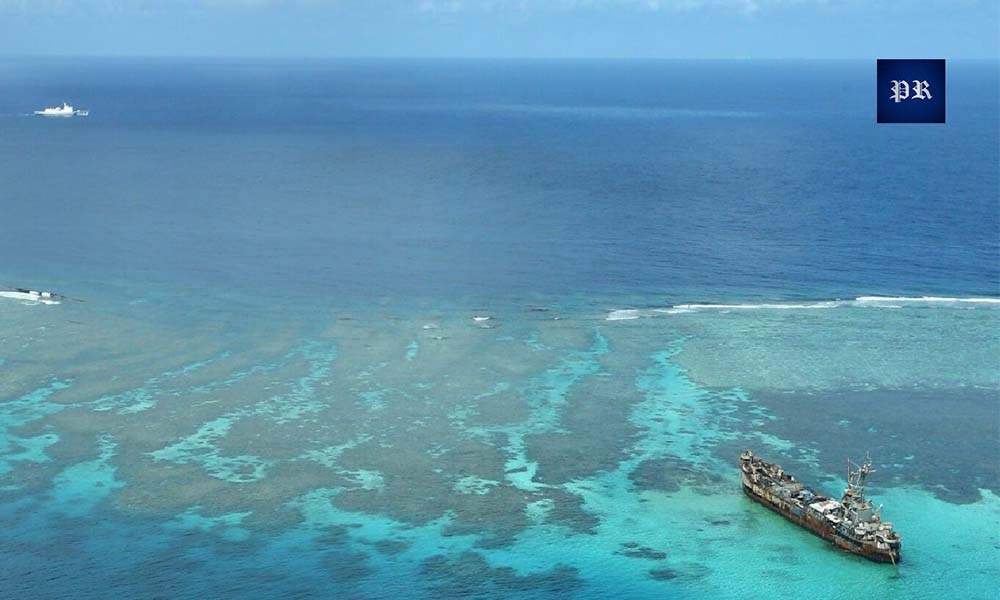
The drama unfolded on or around August 11, 2025, just off the contested waters of Scarborough Shoal, known to Filipinos as Panatag Shoal, and to Beijing as Huangyan Dao. This triangular reef, just 120 nautical miles off Luzon, has long been a flashpoint of sovereignty and survival. But this time, it became the site of a stunning accident that Beijing would rather erase from memory.
At the heart of the collision were two Chinese ships, the China Coast Guard’s CG3104 and a Type 056 corvette from the People’s Liberation Army Navy. Analysts quickly identified the CCG vessel in satellite photos, its bow crushed inward, an unmistakable sign of heavy impact. The presence of the PLAN corvette alongside the coast guard cutter revealed something crucial: this wasn’t just law enforcement. It was a coordinated gray-zone operation where China’s coast guard and navy worked hand in glove to hound a much smaller Philippine ship.
That Philippine vessel was the BRP Suluan, a modest cutter on what should have been a routine mission: delivering supplies to Filipino fishermen in their own waters. But routine doesn’t exist at Scarborough anymore. The Suluan found itself boxed in by China’s larger hulls, facing the full brunt of Beijing’s playbook, water cannons, aggressive shadowing, and high-speed interception runs meant to intimidate, not fight, but always with the threat of escalation hovering in the background.
Then came the chaos. In their rush to block the Philippine cutter, the CCG and PLAN vessels miscalculated. Video footage later released by the Philippine Coast Guard shows the surreal moment: two Chinese ships, supposed to be working in tandem, slamming into each other instead. The CG3104’s bow crumpled under the force, while the PLAN corvette’s side was gashed open. Ironically, the much smaller BRP Suluan escaped unscathed, weaving through the melee as its adversaries collided with each other.
The diplomatic fallout was immediate, though tellingly lopsided. Beijing stuck to its familiar script, accusing the Philippines of “illegal entry” and “dangerous maneuvers” in what it still insists are its sovereign waters. But conspicuously, China never acknowledged the collision itself. Not a word about its own vessels’ damage. Not a hint of embarrassment admitted.
Manila, by contrast, seized the moment. The Philippine Coast Guard not only released the video footage but also amplified the narrative: Chinese “poor seamanship,” “reckless gray-zone tactics,” and, in Commodore Jay Tarriela’s words, a “fratricidal collision” that revealed the flaws in Beijing’s intimidation strategy. For Filipinos, the footage became a source of pride: a small cutter standing firm while two giants fumbled. For the world, it was yet another reminder of how easily the South China Sea’s dangerous game of chicken can spiral out of control.
Broader Geopolitical Implications and Context
The August 2025 collision was not just a freak accident at sea, it was the inevitable outcome of a conflict that has been simmering for decades. At the heart of it lies the South China Sea, a maritime crossroads that carries trillions in trade and is rich in oil, gas, and fisheries. Beijing insists that almost the entire area falls within its so-called “nine-dash line” , an expansive, sweeping claim that stretches thousands of kilometers from its coast. But in 2016, the Permanent Court of Arbitration in The Hague ruled the claim baseless, declaring it illegal under the United Nations Convention on the Law of the Sea (UNCLOS). For Manila, that ruling was a lifeline; for Beijing, it was a verdict to be ignored. And ignored it has been, through ships, blockades, and an unrelenting campaign of presence.
Few places symbolize this dispute more than Scarborough Shoal. Barely 120 nautical miles from the Philippine coast, it has long served as a traditional fishing ground for Filipinos, Vietnamese, and Chinese alike. But since 2012, when China wrested effective control of the reef, it has become a flashpoint for confrontation. For Filipino fishermen, Scarborough is survival. For China, it is a strategic prize, a sentinel at the edge of the Luzon Strait, a potential bastion in the event of conflict over Taiwan. That’s why every resupply mission, every coast guard deployment, becomes more than just a fishing dispute, it becomes a proxy battle over sovereignty and security.
The collision itself is a case study in China’s “gray zone” strategy. Rather than resorting to outright war, Beijing prefers to operate in the shadows of legality, deploying its coast guard, swarms of maritime militia, and even naval escorts to harass, block, and intimidate rivals. These actions stop short of actual combat, but they carry the same psychological weight: eroding the will of smaller nations, normalizing Chinese dominance, and pushing sovereignty boundaries one confrontation at a time. The Scarborough crash showed the danger of this tactic. In trying to intimidate a much smaller Philippine vessel, China ended up colliding with itself, an accident born out of escalation, and a reminder of how thin the margin is between provocation and catastrophe.
The data paints a stark picture. In June 2025, the Philippine Navy recorded 49 Chinese vessels operating across three contested zones, the highest monthly total of the year. That number represents not just an increase in presence, but an increase in risk. More ships mean more encounters, and more encounters mean more chances for collisions, accidents, or worse.
And the world is responding. The Philippines has not been alone in facing this pressure, it has been backed by an increasingly visible coalition of allies. Recent joint military drills with the United States, Australia, and Canada signal that the standoffs at sea are no longer a bilateral issue between Manila and Beijing. They are now a litmus test for the international community’s resolve to defend freedom of navigation and a rules-based order in the Indo-Pacific. Each exercise, each joint patrol, is both a deterrent and a warning: if the South China Sea is the stage, then Scarborough is one of its brightest spotlights.
Repair Methods and Their Significance
When satellites from companies like Maxar and Planet Labs first revealed the damaged Chinese Coast Guard cutter docked at the Yulin Naval Base in Hainan, the images told a story Beijing was desperately trying to bury. The vessel, identified by analysts as CG3104, sat alongside two tugs, its bow visibly crushed inward from a head-on collision. Officially, China remained silent. But steel does not lie. The ship was broken, and the world was watching as Beijing rushed to repair both the vessel and its image.
This was no ordinary repair job. The reconstruction of a ship’s bow, especially a coast guard cutter that was originally a repurposed navy corvette is a massive undertaking that blends technical skill with political urgency. To fully understand the significance, we need to break down how such a repair is done, why the choice of repair site matters, and what it reveals about the blurred line between China’s navy and coast guard, a line that Beijing insists doesn’t exist, but one that satellite imagery continues to expose.
A. Common Hull Repair Methods: Rebuilding the Broken Bow
In the world of naval architecture, the bow of a ship is its face. It cuts through the waves, bears the brunt of collisions, and defines seaworthiness. When that bow collapses, as CG3104’s did, the damage is not cosmetic, it is structural. That means repairs cannot be done with a quick patch or surface welding. The vessel must be taken into a dry dock, a specialized facility where water is drained so the entire hull can be exposed.
China Threatens to Tow Philippines BRP Sierra Madre Can Manila Stop It?
Inside the dry dock, engineers begin by assessing the frame. The bow is often built with layered steel plating supported by internal frames. A collision can warp not only the visible plates but also the hidden ribs of the hull, creating unseen weaknesses. The first step is therefore cutting away the destroyed sections, using plasma cutting or precision oxy-fuel torches to slice through the warped steel.
Next comes replacement. Modern shipyards no longer rebuild plates piece by piece. Instead, they rely on prefabricated modules, large sections of hull manufactured in controlled environments, where steel is cut, shaped, and welded with machine precision. These modules are then transported to the dry dock and fitted into place, like a surgeon transplanting a bone graft.
To ensure strength and durability, shipyards use automated welding techniques, robotic arms that guarantee consistency, avoiding human error in long weld lines. Each weld must pass non-destructive testing (NDT), using ultrasound or X-rays to detect hidden cracks. The repaired bow must be as strong as the original or stronger, if the ship is to return to contested waters like Scarborough Shoal.
In the final stages, the hull is treated with anti-corrosive coatings and hydrodynamic paint, restoring not just function but efficiency. A vessel with a crushed bow cannot cut cleanly through water, costing speed and fuel. The repaired bow is therefore reshaped with precision to restore the vessel’s ability to perform high-speed “shouldering maneuvers”, the very tactic that caused the accident in the first place.
B. The Significance of the Naval Base: Yulin as China’s Silent Partner
The fact that CG3104 ended up at the Yulin Naval Base, one of China’s most important naval hubs on Hainan Island, is more than a logistical choice, it’s a political signal. Yulin is no ordinary port. It houses China’s nuclear submarine fleet, its carrier battle groups, and advanced facilities for repair and resupply. By bringing a coast guard vessel here, Beijing underscored what analysts have long argued: China’s Coast Guard is effectively an arm of the People’s Liberation Army Navy (PLAN).
This is not the norm. In most countries, the coast guard is civilian, tasked with rescue operations, law enforcement, and maritime safety. In the Philippines, for example, the Coast Guard operates under the Department of Transportation, separate from the navy. But in China, the coast guard was brought under the Central Military Commission in 2018, effectively making it a military force in all but name.
Repairing CG3104 at Yulin Naval Base rather than at a civilian coast guard dock drives this point home. It shows the interchangeability of China’s “white hulls” and “gray hulls.” A coast guard cutter can be repaired in the same dock as a nuclear submarine, redeployed alongside navy corvettes, and used in tandem with militia boats. To Beijing, these are not separate arms of statecraft, they are one continuum of force, deployed flexibly depending on the level of plausible deniability needed.
As one analyst from the U.S. Naval War College put it: “When a Chinese coast guard cutter sails, it carries the weight of the navy. When it docks, it docks like a warship.
Philippines Faces Chinese Naval Blockade in Escalating Scarborough Shoal Standoff
Advanced Repair Techniques: Speed as Strategy
Time is everything in this repair. Every day CG3104 sits in dock is a day it cannot join China’s “gray zone” patrols in the South China Sea. For Beijing, absence equals weakness, an opening for the Philippines and its allies to push harder with resupply missions, joint patrols, or even legal campaigns, without the constant shadow of harassment. That’s why China is throwing its most advanced repair techniques at the problem, determined to minimize downtime and get the vessel back in the water before momentum shifts.
One of the key methods being used is automated welding. In traditional repairs, teams of human welders painstakingly lay down seams, but automation changes the equation. Specialized rigs can deliver long, continuous welds with fewer errors and greater structural integrity. For a ship like CG3104, which China routinely employs in aggressive “bumping” maneuvers against foreign vessels, durability is just as important as speed. Automated welding ensures the new bow can withstand the stresses of deliberate collisions.
Another crucial step is precision cutting and removal. Using laser-guided tools, engineers can slice away only the warped and crushed sections of the hull while preserving intact frames. This reduces the amount of new steel required, minimizes wasted effort, and streamlines the reconstruction process. Instead of tearing out massive sections, they target the exact damage, a surgical approach that saves time and resources.
But perhaps the most significant innovation is prefabricated modular replacement. Instead of constructing the new bow piece-by-piece inside the dock, large replacement sections are built in parallel at nearby facilities. Once completed, these modules are transported and fitted onto the ship like plug-and-play parts. This modular strategy can slash repair timelines dramatically, from what would normally take months down to just weeks, allowing China to quickly redeploy the vessel back into contested waters.
Satellite imagery confirms this race against time. Analysts have spotted new cranes, freshly delivered steel modules, and unusual levels of activity around the Yulin dry dock, suggesting a surge in resources dedicated to this single repair. It’s not just about fixing a ship, it’s about repairing China’s image, regaining lost momentum, and ensuring that CG3104 returns to service before the world’s attention drifts elsewhere. These repairs are as much about politics and perception as they are about steel and welding arcs.
Expert Commentary: What the Repairs Reveal
For experts, the repairs confirm what has long been suspected: China’s Coast Guard is a militarized extension of its navy.
Collin Koh of the S. Rajaratnam School of International Studies put it bluntly: “Since CG3104 was originally a navy corvette, it is natural for the vessel to return to a naval base for repairs rather than a coast guard base. This is not just convenience, it reflects how blurred the lines are between the PLAN and the CCG.”
This blurring is not accidental. It is deliberate. By converting old naval corvettes into coast guard cutters, China gives itself dual-use assets, vessels that can intimidate fishermen one day and engage in near-combat maneuvers the next. When they’re damaged, they return to naval docks. When they sail, they sail under coast guard colors. This flexibility allows Beijing to escalate and de-escalate at will, maintaining deniability while keeping pressure constant.
But experts also note a deeper irony. By colliding with its own PLAN escort, the CCG exposed the limits of gray-zone tactics. Aggressive maneuvers rely on discipline, coordination, and precise seamanship. When those fail, the façade of competence crumbles. As one maritime analyst observed: “The Scarborough collision was supposed to intimidate the Philippines. Instead, it embarrassed China.”
Symbolism Beyond Steel: Why These Repairs Matter
In the end, the repairs on CG3104 are about far more than restoring a damaged hull. They stand as a powerful symbol of the broader contest of narratives unfolding in the South China Sea, where every move is scrutinized not only for its tactical value but also for its political and symbolic weight.
For Beijing, getting the vessel fixed quickly and quietly is about more than seaworthiness, it’s about credibility. A crippled coast guard cutter sitting idle in dock is a visible scar, a reminder that even China’s carefully choreographed intimidation tactics can go wrong. To the Chinese leadership, silence and speed are essential; to admit vulnerability is to admit that its “gray-zone” dominance is not as unshakable as it claims.
For the Philippines, however, every extra day the ship remains in repair is a propaganda victory. It proves to its people and to the world, that even a modest vessel like the BRP Suluan can outmaneuver larger, supposedly superior forces. Each satellite photo of CG3104 in dry dock reinforces the David-versus-Goliath narrative Manila has embraced: small, determined ships standing their ground against an overbearing giant.
Diokno Pushes Philippines to Rejoin ICC Amid Escalating South China Sea Aggression by China
And for the international community, the satellite imagery offers something more: evidence. It underscores that China’s Coast Guard is not a benign, civilian agency, but a militarized force operating under naval oversight, indistinguishable from an arm of the PLA itself. The very fact that CG3104 is being repaired at a major naval base, not a civilian facility, erases any illusion of separation.
The welding arcs at Yulin Naval Base, then, are more than sparks striking steel. They are sparks on a powder keg, a vivid reminder of how fragile, risky, and escalatory China’s gray-zone operations have become. What appears on the surface to be a technical fix is, at its core, a geopolitical statement: in the South China Sea, even the smallest collision reverberates across the global order.
Conclusion: Looking Ahead
The satellite images out of Hainan do more than show a ship under repair, they confirm what Beijing refused to admit. The crushed bow of China Coast Guard vessel CG3104, tucked into Yulin Naval Base under the shadow of warships and submarines, is independent proof of the August collision near Scarborough Shoal. No amount of silence or propaganda can erase what steel and satellite lenses reveal: China’s aggressive maneuvers not only endangered the Philippines but also backfired on its own fleet.
But this was never just about one damaged hull. The collision and rushed repairs point to a larger pattern of escalation, where “gray zone” tactics of blocking, ramming, and intimidation are pushing the South China Sea toward a breaking point. Each high-speed chase, each water cannon blast, each shadowing maneuver raises the chance of another collision, one that might not just embarrass Beijing but could ignite a wider confrontation.
And that is the final lesson here: the images from space are not just about a broken ship, they are about a broken strategy. China’s relentless use of its Coast Guard as an arm of power projection, cloaked in white paint but welded in a naval dock, threatens not just Philippine sovereignty but maritime safety, global trade, and the very principles of international law. The South China Sea is one of the world’s most critical arteries, carrying trillions in commerce, and yet it is being turned into a playground of dangerous brinkmanship.
The truth is simple: the collision at Scarborough and its satellite aftermath are a warning. The line between “peacetime harassment” and “accidental war” is thinner than ever. And unless the world confronts these gray-zone tactics with unity and resolve, the next spark in these contested waters may not end with repairs in a dockyard but with a crisis no one can control